Having completed our Stocktake & Gap Analysis in January of this year—and thanks to the support of the Systemic Climate Action Collaborative, we’ve spent the past six months steadily feeling our way toward laying the foundations of a Bioregional Financing Facility (BFF) for the Tay Bioregion.
In this first of a two part update on our work, we summarise what problem we are trying to solve. In the second part (see the next post), we explore how the Bioregional Financing Facility can form the ‘connective tissue’ between bioregions and capital.
Skillfully guided by Leon Seefeld and Rosa Brand of Dark Matter Labs, each step of our process has been anchored in the same essential question:
What problem are we trying to solve?
As our work evolves, so too does our language and our framing. Here is how we are currently articulating the problem we are responding to.
The Problem: A Missing Financial Architecture for Regeneration
Our Bioregional Financing Facility is grounded in a simple but urgent recognition:
Healthy, thriving bioregions are not optional.
They are the foundation of long-term economic resilience, climate adaptation, and human well-being.
As the global “polycrisis” deepens—climate disruption, biodiversity collapse, widening inequality—regenerative efforts can no longer be treated as peripheral, or as “projects.” They must be recognised and funded as essential infrastructure.
At the heart of the problem is this:
We lack a coherent financial architecture capable of funding and sustaining regenerative transitions at the bioregional scale.
Without structures that can steward capital across interconnected systems and capture ecological, social, and cultural value, investment remains piecemeal and reactive.
The Tay Bioregion’s BFF seeks to change that by enabling long-term, systemic, place-based portfolios and diverse flows of capital aligned with bioregional health.
Regeneration Requires Systemic, Place-Based Portfolios—but the Conditions Aren’t There Yet
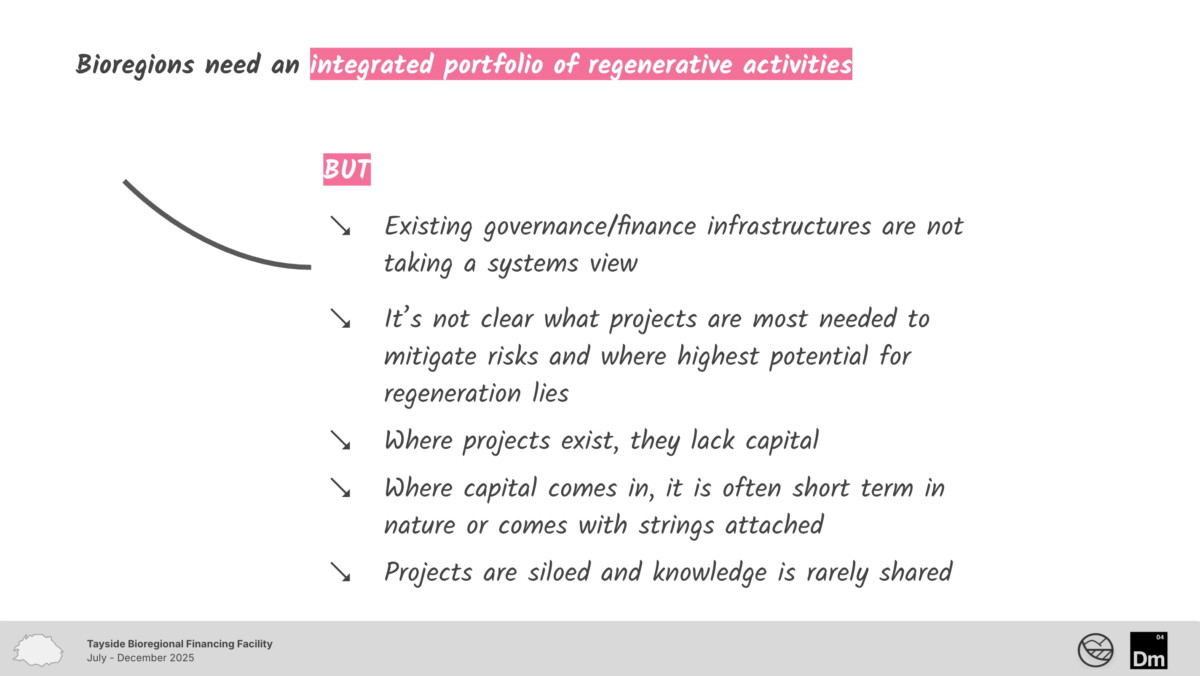
To regenerate a bioregion, we need systemic, place-based portfolios of regenerative activities.
However, we face a series of disabling conditions that currently prevent this.
Disabling conditions we’re observing in the Tay Bioregion include:
- Unclear priorities: Systems thinking is not mainstream, leading to competing views of where projects are most needed or where the greatest regenerative potential lies.
- Capacity gaps: Many regenerative projects lack time and expertise to develop them
- Lack of capital: overall there’s not enough money available that is targeting regeneration and limited relevant development support
- Misaligned capital: Funding is often short-term, insufficient, or constrained by conditions that drive overextension and undercapitalisation.
- Governance structures: (that determine how money gets allocated) often fail to see the system, default to the status quo, or reinforce existing power arrangements.
- Siloed efforts: Projects operate in isolation, with weak knowledge-sharing networks and limited capacity to participate in them.
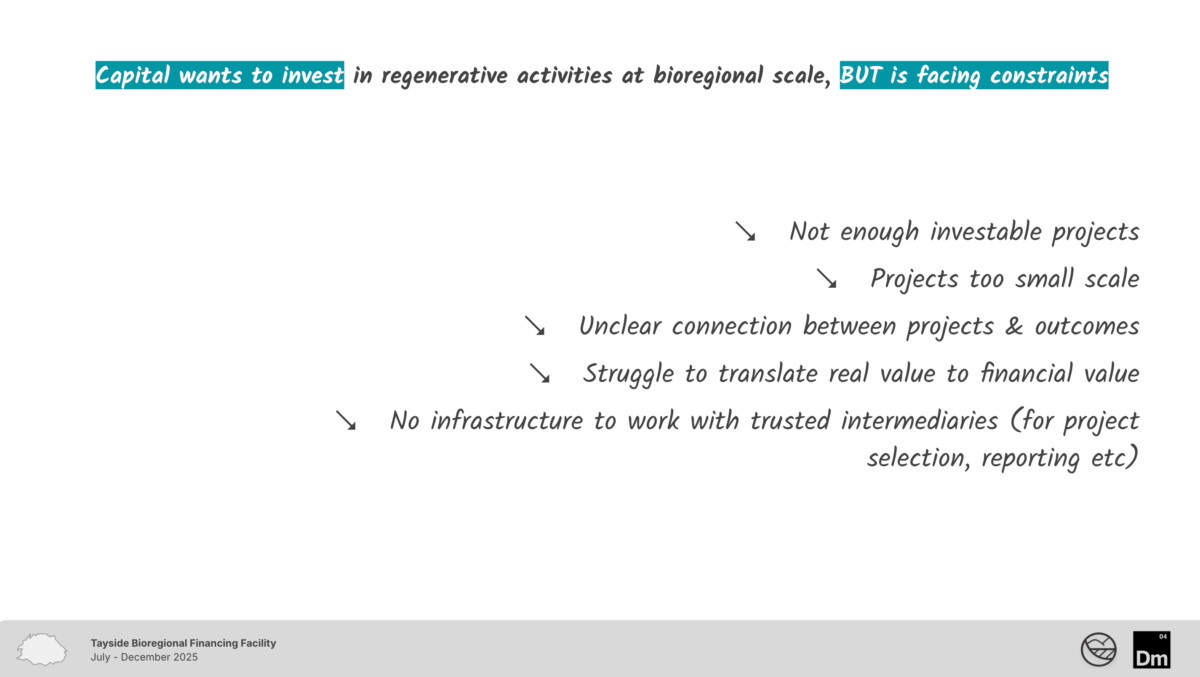
Alongside the challenges on the ground, we’ve deepened our understanding of the capital-side constraints that restrict investment in regenerative transitions.
- Not enough investable projects
Many initiatives have strong promise but lack:
- Business models
- Governance structures
- Data and due diligence readiness
- Early-stage funding to become “bankable”
- Projects are too small
Most regenerative activities are local and site-specific—too small for institutional investors and too fragmented to create portfolio-level impact.
Underlying issues include:
- Fragmented land ownership
- No mechanisms for aggregation
- Investors accustomed to large, mature, standardised deals
- Unclear connection between projects and outcomes
Regenerative projects produce multi-dimensional outcomes that are:
- Hard to measure
- Slow to manifest
This is compounded by:
- A lack of common bioregional health indicators
- Weak data and monitoring systems
- Misaligned investment time horizons
- Difficulty translating real value into financial value
Regeneration creates enormous ecological and social value—most of which is:
- Public good
- Unpriced
- Uncaptured by markets
This reflects broader issues of market failure and the dominance of purely financial valuation metrics.
- Lack of governance infrastructure and trusted intermediaries
Investors require:
- Aggregators
- Monitors
- Trusted reporting entities
- Structures that enable capital to connect to communities
But in most bioregions—including ours—these structures are nascent or under-resourced.

Despite the challenges, we now have a clearer view of how Bioregional Financing Facilities can bridge the gap between regenerative ambition and investable reality.
A BFF can:
- Identify what needs to be done to support regeneration and how to measure success
- Weave projects into a systemic portfolio of synergistic activities
- Surface stakeholders’ shared dependence on a healthy bioregion and fostering a sense of agency
- Build investment instruments scaffolded by community priorities and long term relationships
With this connective tissue in place, a landscape of isolated projects can evolve into a systemic investment platform capable of driving long-term regenerative transformation.
Next Up
Read Part Two of “Feeling for the Foundations” to explore what this connective tissue could look like in the Tay Bioregion—and how it could enable the kind of place-based regenerative transition our time demands.
This entry was posted in News