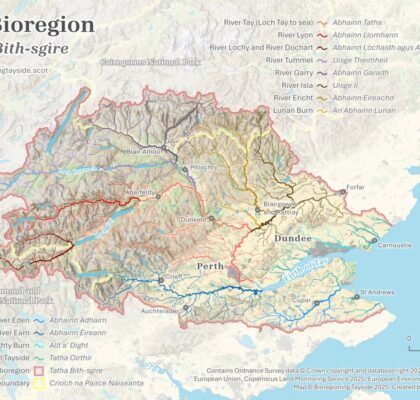
In Part One of this two part update on our Bioregional Financing Facility work, we explored the systemic challenges facing regenerative finance in the Tay Bioregion and why a Bioregional Financing Facility (BFF) is needed to bridge the gap between regenerative ambition and investable reality.
In this second part, we turn to the question at the centre of the current stage of our work:
How could the Tay Bioregion’s BFF begin building the connective tissue that enables regenerative practices to proliferate and attract the financial capital needed?
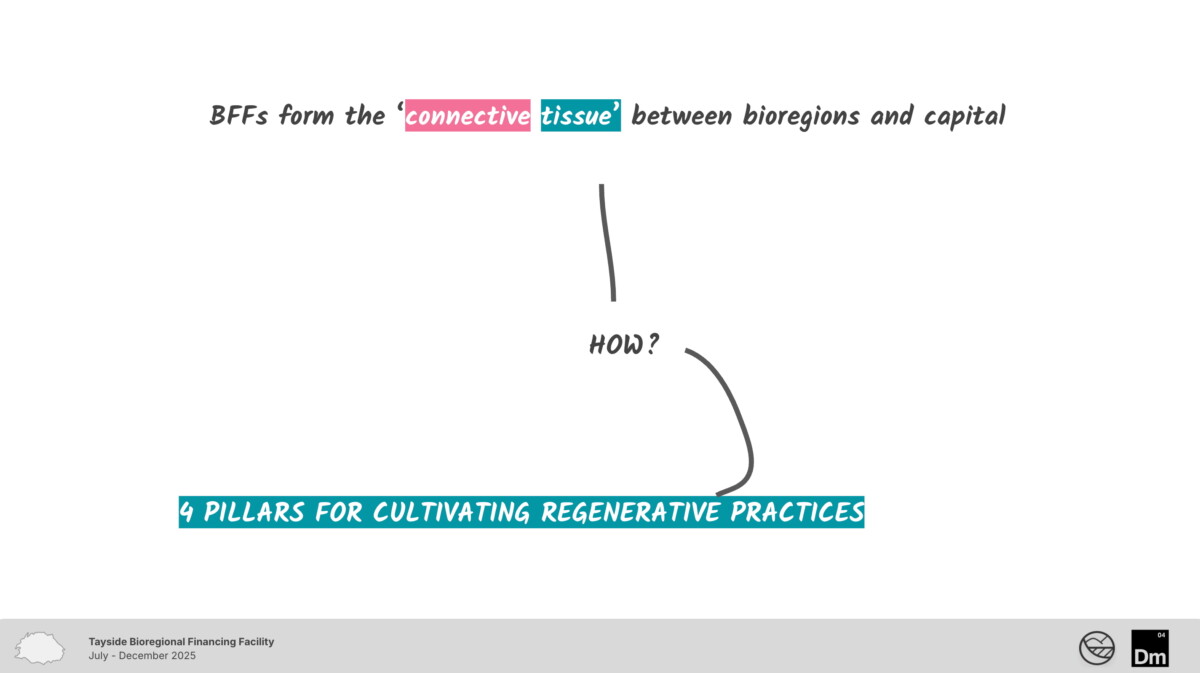
To help structure our thinking, we’ve organised the challenges and potential pathways into four pillars for cultivating regenerative practices.
These four pillars help us map what exists, what’s missing, and what needs to be built so that regenerative practices become the norm rather than the exception.
Pillar 1 – Projects
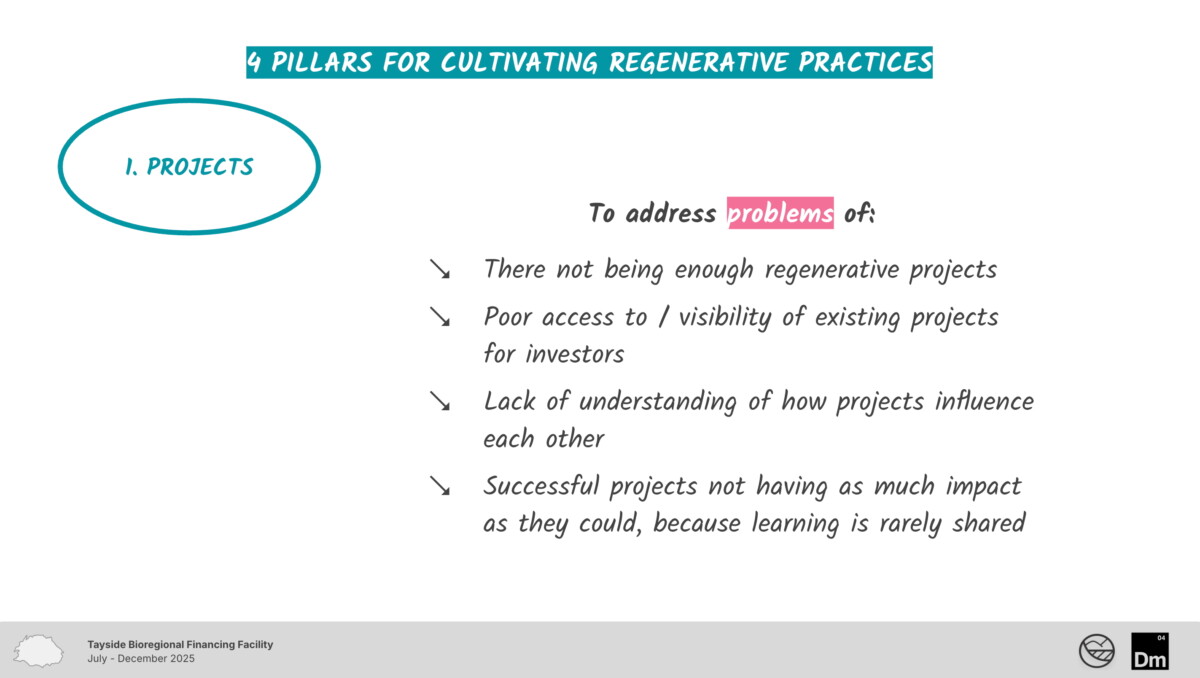
The first pillar focuses on how we build the portfolio of regenerative projects that are looking for financial capital given that:
- There are not enough regenerative projects yet in our Bioregion. (By regenerative projects we mean initiatives that apply systems thinking to go beyond maintaining or minimizing harm—actively restoring what’s been lost and weaving together community, ecology, culture, and economy to build resilience at the scale of place.)
- Regenerative projects that are already in play and those that are being planned lack visibility and/or may not have developed ‘investment readiness’ for reasons previously explained in Part 1.
- There is not enough collective understanding of how these projects might influence each other or create critical mass for systems change – for example, we have been told that not all organic farmers know where other organic farmers are located in the Bioregion and Bioregioning Tayside itself is yet to identify all the key leverage points for systems change within its own four key elements, Land, Water, Human Communities and Biotic Communities.
- Learning from successful projects is often insufficiently shared reducing spillover impact and/or scaling potential, again for reasons explained in Part 1.
So we’ve been asking:
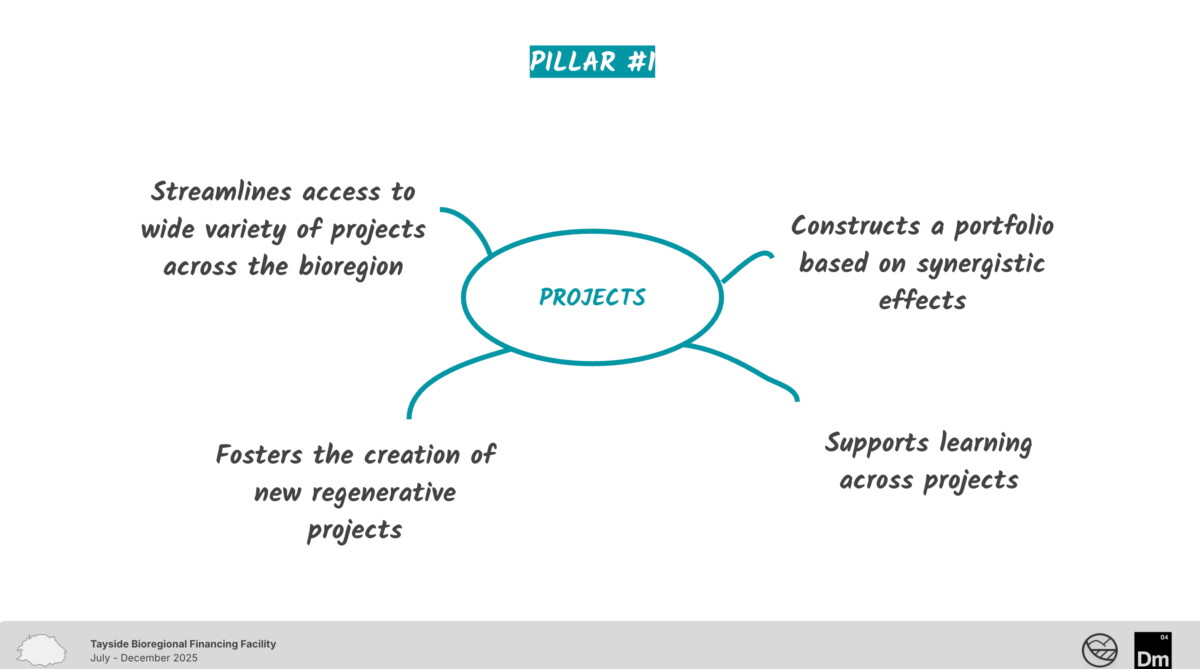
What enabling conditions need to be built to foster project creation, visibility, connectivity, and shared learning?
What’s happened so far
Co-creation of regenerative projects
Over the past three years, Bioregioning Tayside has been laying some of the foundations for the BFF by actively co-creating and resourcing projects on the ground. These efforts have begun to build our understanding of what some of the enabling conditions for Bioregional work are: system awareness, relationships and trust, information and knowledge flows, the need for increased agency and power sharing and the necessity of properly resourcing these enabling conditions.
Examples include:
- The River Ericht Catchment Restoration Initiative: undertaking ecological baselining and beginning to work out what nature restoration might be possible and where, bringing different communities of interest and place in the catchment together, modelling early stage options for governance and finance and bringing a second wave of finance to the table that is enabling landowners to develop nature restoration projects on the ground and the restoration vision to be further developed.
- Food systems transformation work: Developing understanding of what the enabling conditions are to strengthen community-led food growing in the Bioregion and initiating the investment case for reviving the Bioregion’s orchard economy.
- Mapping and ecological baseline work: Making visible the ecological conditions and projects already active in key subcatchments.
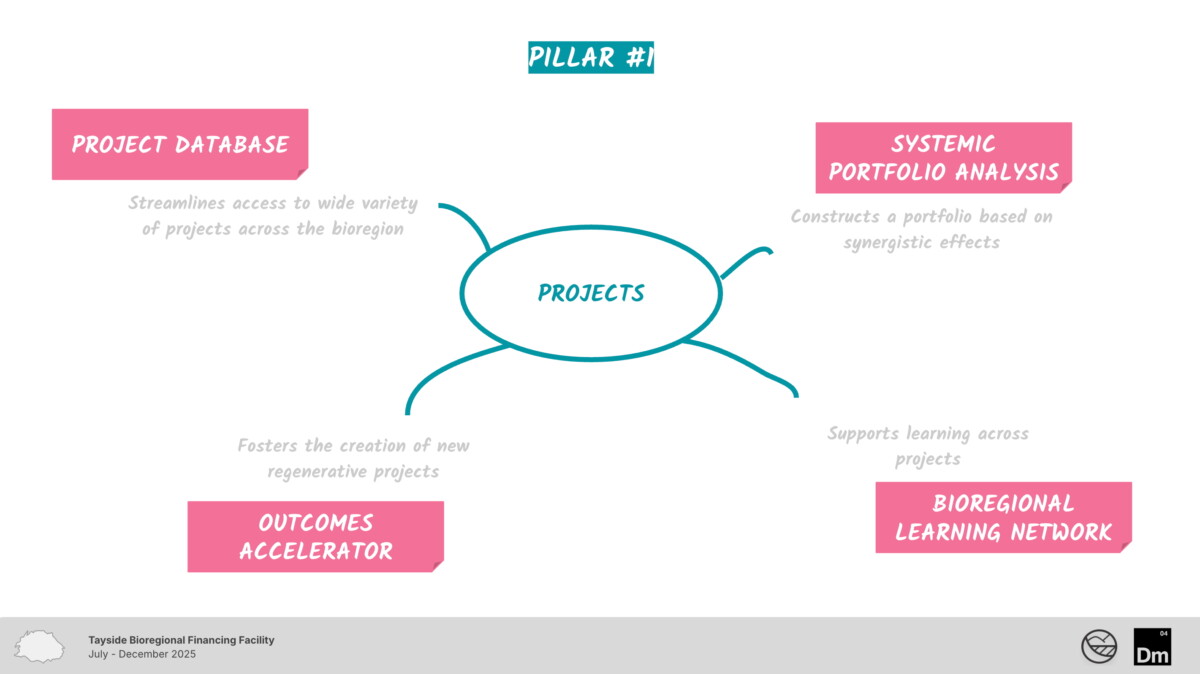
- Streamlining access to a variety of projects: We’ve created an online project platform, where regenerative initiatives can be proposed, surfaced, and explored.
Route map for 2026
In 2026, through an expanded operational team, thanks to new core funding from the NoVo Foundation, we plan to:
- Continue to build the project database.
- Develop the Bioregional Learning Network proposition and begin attracting funding into pilot programmes.
- Advance systemic portfolio analysis by learning from the early stage scenario modelling demonstrator that we have embarked on for the Isla Catchment.
- Support project investment readiness through an Outcomes Accelerator.
Create a Bioregional Road Show to travel to 4 catchments in the Bioregion with the aim of sharing these ideas, involving more people in their development and helping to generate a richer pipeline of regenerative initiatives for the project database.
Pillar 2 – Intelligence
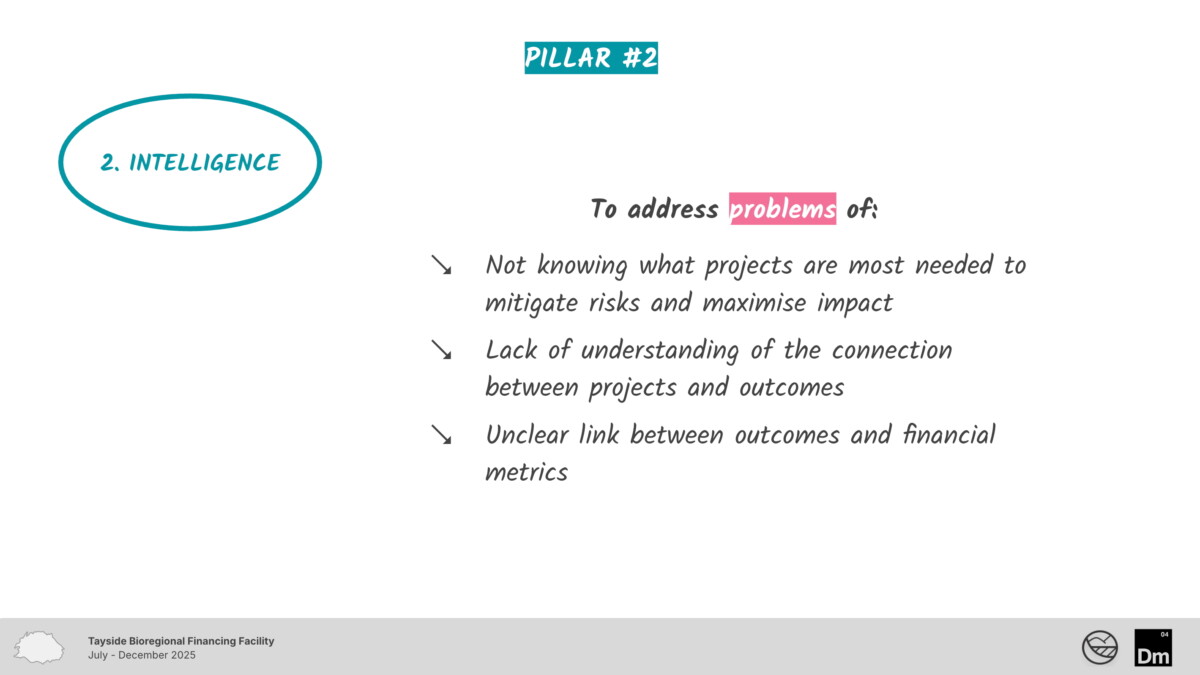
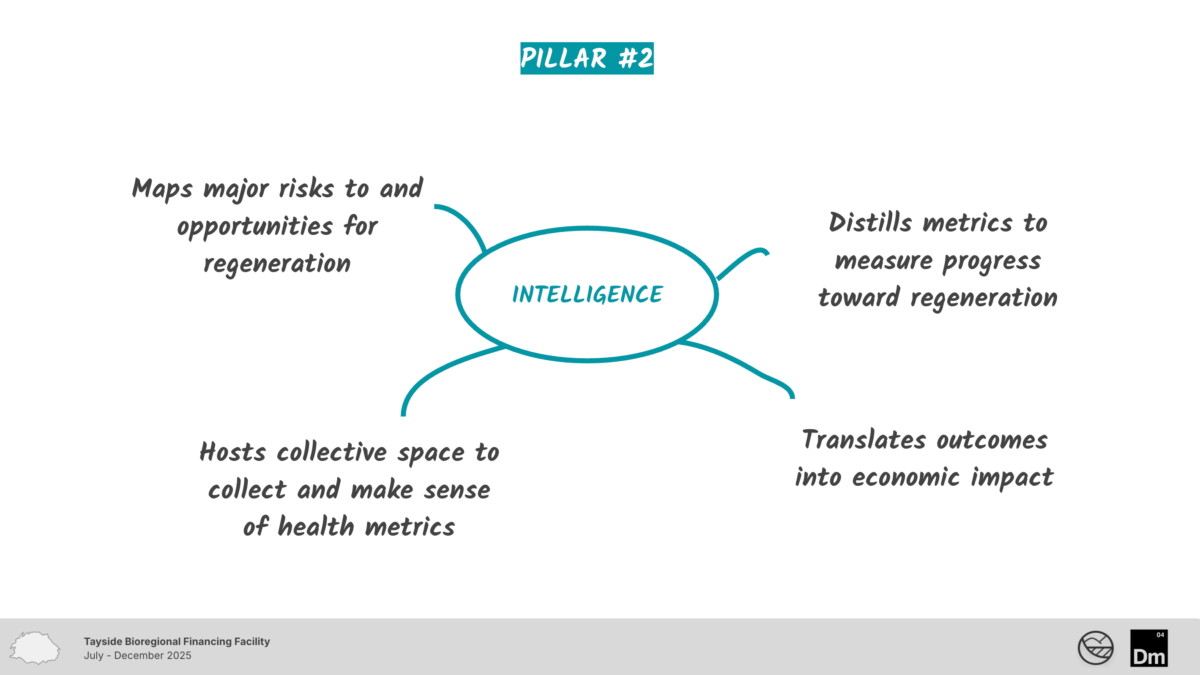
The second pillar addresses the intelligence gap.
Today, we still lack:
- A clear understanding of what projects are most needed.
- A way to connect projects to outcomes.
- A link between outcomes and financial metrics.
So we are working to build the intelligence infrastructure for the Bioregion.
What’s happened so far
Over the last few months, we have been drafting a Framework For Action for the Tay Bioregion which begins to identify risks to and opportunities for regeneration. This:
- Describes the Bioregion through four frames (Land, Water, Biotic and Human Communities).
- Outlines a diagnostic of the health of the Bioregion.
- Proposes 5, 10 and 20 year scenarios that we could collectively work towards to improve the health of the Bioregion.
- Outlines the enabling conditions needed to move into those scenarios, together with transition pathways.
- Proposes a new infrastructure for governance, collaboration and financing.
We’ve also been continuing our Community-led landscape monitoring enquiry: mapping and documenting existing participatory science in the Bioregion and documenting common challenges and laying foundations for a new data and governance infrastructure that could grow community engagement in monitoring local and regional landscape change.
Route map for 2026:
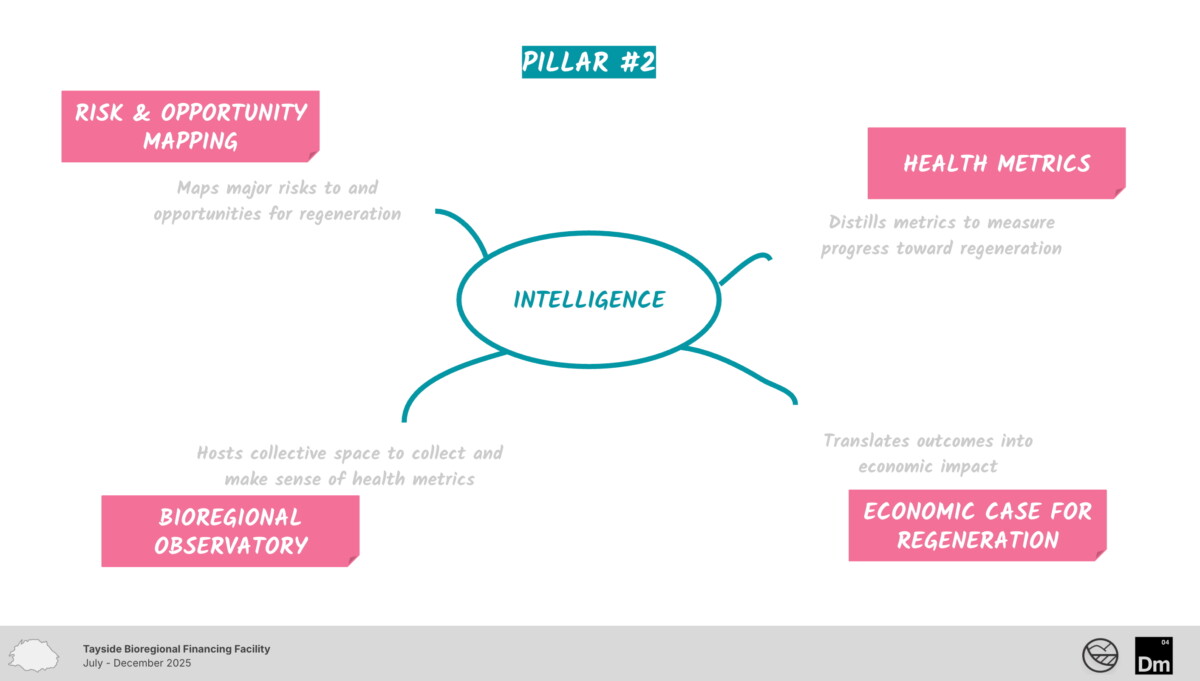
- An early approach to developing Bioregional Health Metrics is being developed with Dark Matter Labs.
- One approach to developing the economic case for regeneration is being developed through the Isla Catchment scenario modelling demonstrator project in collaboration with Ecosystemiq.
- Through our 3 year enquiry into how communities can get more involved in monitoring landscape change on their doorstep, supported by NatureScot, we have begun to design an approach to initiating the Bioregional Observatory – the proposed intelligence, observation, and sense-making hub for the Bioregion.
- Our ‘Bioregional Road Show’ will give us the opportunity to share the draft Framework for Action and continue our risk and opportunity mapping, drawing in a wider range of views.
Some funding is in place; additional resources will be required to continue this work.
Pillar 3 – Governance
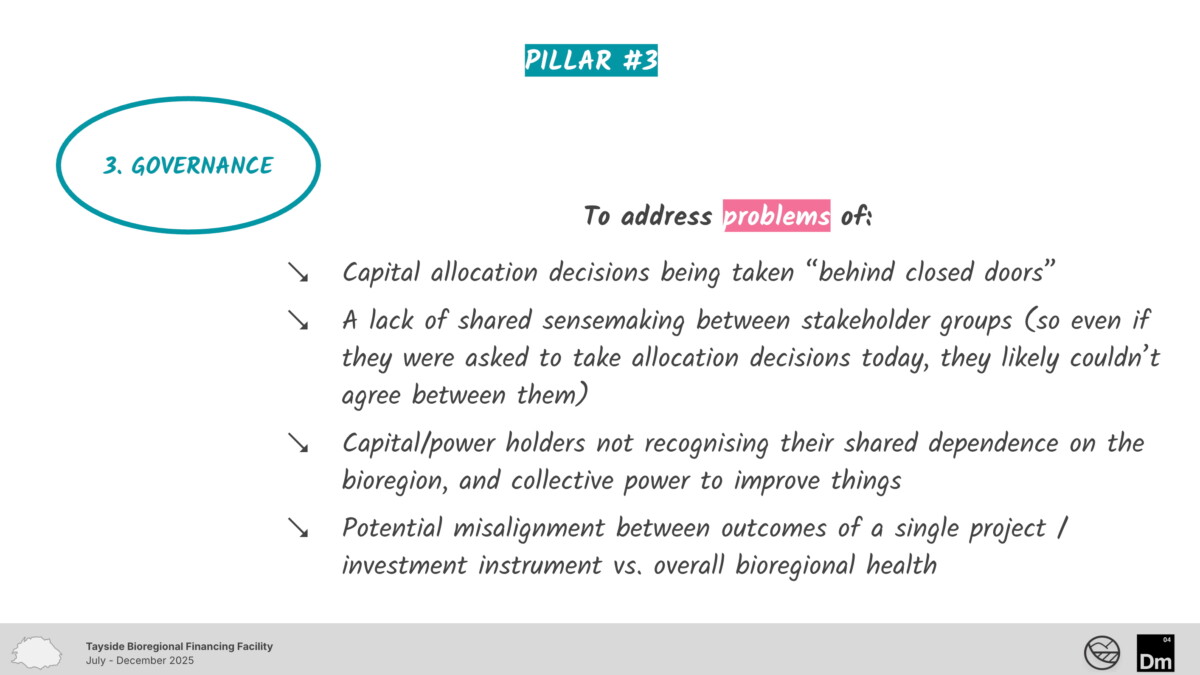
The third pillar focuses on how we develop the governance and collaboration infrastructure for the Bioregion, including the Bioregional Financing Facility given that:
- Current funding infrastructures generally make capital allocation decisions ‘behind closed doors’.
- It is not common practice for sensemaking to happen between different communities of practice and place in the Bioregion. This is important because the portfolio to activate systems change needs to be formed and managed by a collection of actors who co-develop and share a broader system view.
- Not all existing capital/power holders recognise their interdependence with the natural infrastructure of the Bioregion, nor their collective power to improve its health.
- There is a danger that the current dominance of ‘point solutions’ funding (where single projects are supported to focus on one particular problem) undercuts our ability to fund other critical drivers of system health that go beyond individual projects.
Route Map for 2026
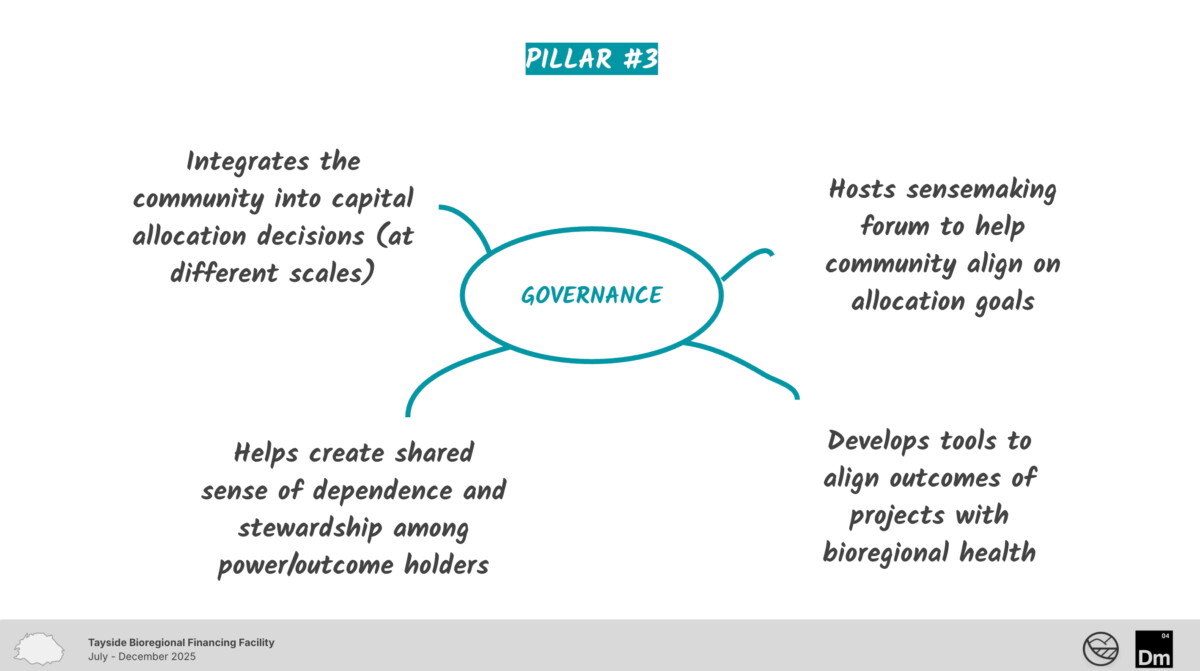
Funding has been confirmed from Commonland to enable us to explore a replicable route map to setting up catchment trusts, in the first instance in the River Ericht catchment. This involves piloting methodologies and participatory design processes that will enable collaborative vision setting, strategy development and an activation route map. Catchment trusts offer the potential of hosting a sense making forum to help communities align on priorities and financial allocation goals. The vision for catchment trusts (to be tested through the design process) is that they are the local custodians of the Tay Bioregion’s living systems. Their core purpose is to anchor bioregional governance in the realities of specific catchments — their rivers, communities, ecologies, and economies. They would serve as both stewards and translators, ensuring that system-wide strategies are shaped by local knowledge, and that local actions contribute meaningfully to bioregional goals. They are the most localised part of the governance infrastructure for the BFF.
An outline approach to participatory capital allocation through a microgranting project has been designed. This aims to test the values of Bioregioning by turning them from abstract principles into criteria for funding, participatory decision-making, and regenerative outcomes framework and a model for how microgranting itself could be seen as a regenerative practice: how the process (how decisions are made, how stories are shared) being as important as the projects funded.
We will start the work around convening an outcome holders alliance – a group of individuals representing diverse nodes of power across the region (landowners, corporates, utilities, public bodies, etc). The aim of this forum is to raise collective awareness that the future thriving of these actors is intrinsically linked to a healthy bioregion, and that they have the collective power to actively shape bioregional health.
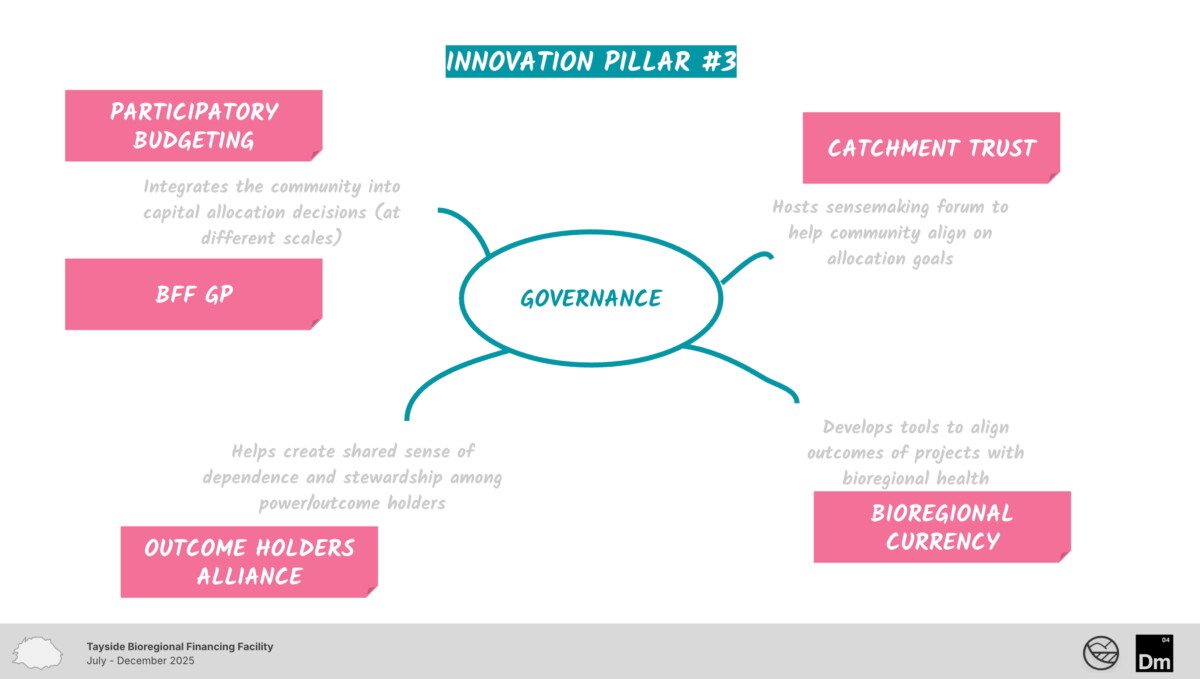
This is what the route map looks like for 2026:
- Work will commence on co-designing the route map for the first catchment trust in the River Ericht Catchment.
- The co-design of the microgranting experience will commence early in the new year whilst funding for the microgranting itself is being sought.
- Convening for the Outcome Holders Alliance will start in the Spring.
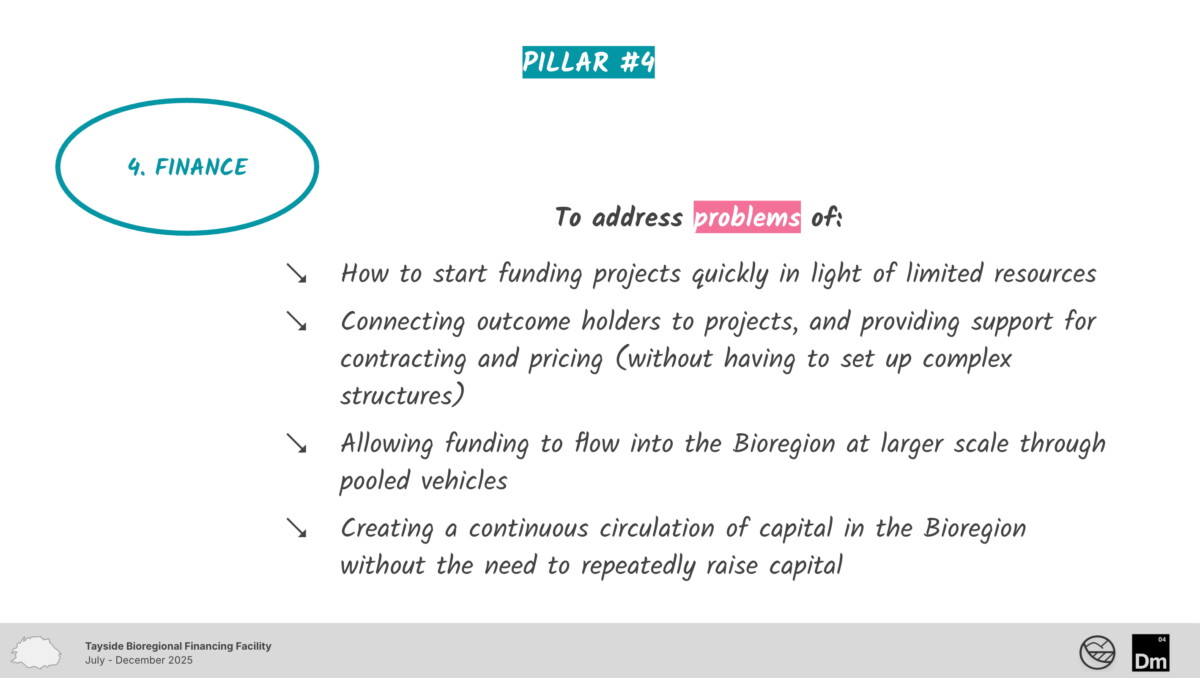
Pillar 4 – Finance
The fourth pillar focuses on how we start to pull finance into the portfolio of regenerative projects given that:
- Despite limited resources for creating the enabling conditions for more regenerative projects and building their investment readiness we need to start funding projects quickly to show proof of concept
- We need to build relationships and understanding between the projects and those that will benefit from their outcomes, providing some support to the projects to enable their delivery
- We need to create new vehicles to allow funding to flow into the Bioregion
- We need to start designing ways of creating a continuous circulation of capital in the Bioregion without the need to repeatedly raise capital
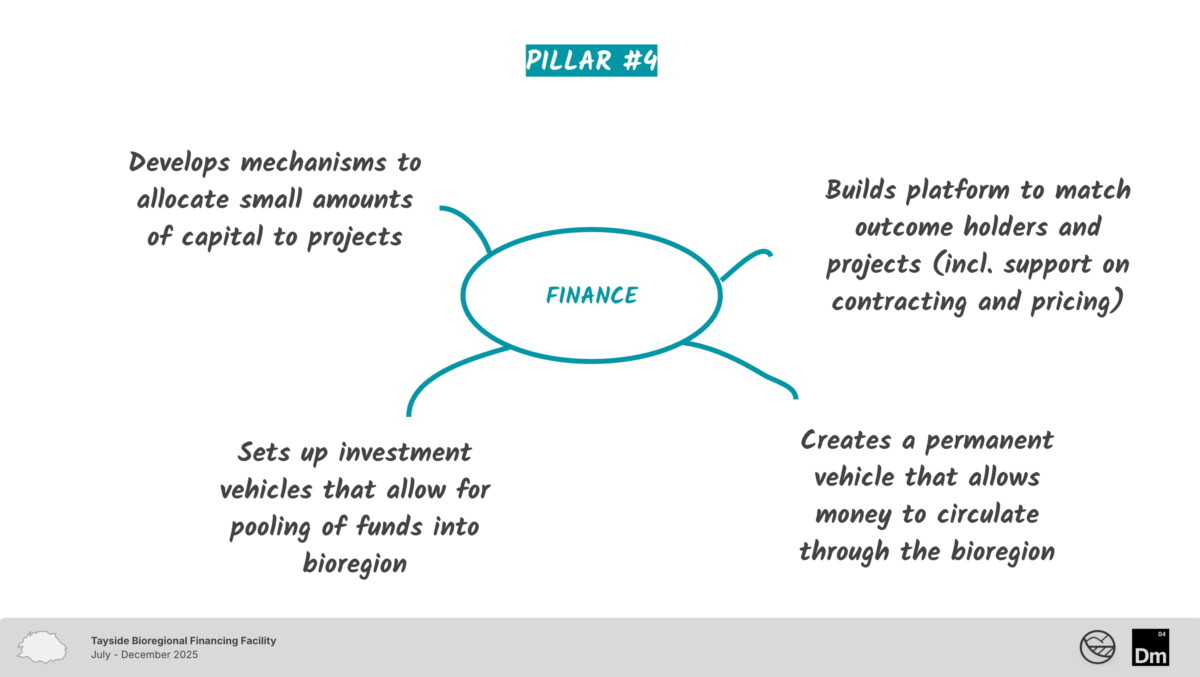
So, what ‘enabling conditions’ can Bioregioning Tayside help build, what is already in place, where are the gaps, what could the route map to filling those gaps look like and what resources need to be brought to the table to start bringing finance in to support regenerative projects in the Bioregion?
- Core funding from the Novo Foundation’s Regional Futures programme will support the production costs of the microgranting experiment.
- Once the Outcome Holders Alliance has been established, we are looking to create a mechanism that connects these actors to project holders on the ground. This Outcomes Exchange is designed to allow bioregional actors to directly provide financial support to projects working on creating the outcomes this actor is most exposed to (e.g. local distillery to support project that increases amount and quality of water).
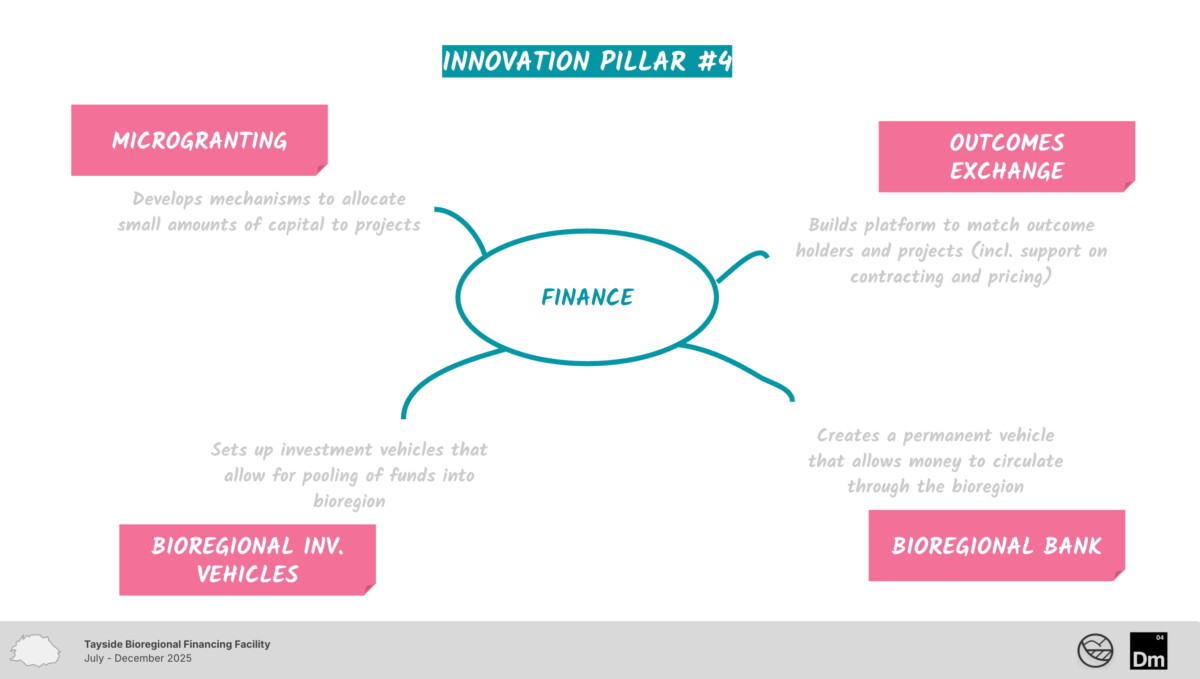
This is what the route map looks like for 2026:
- Capital for microgranting experiment will be raised and the final format of the allocation mechanism and reporting format will be decided.
- Outcomes Exchange will be designed and implementation will begin.
- We will further refine our thinking around the Bioregional Bank – including the potential benefits of creating a bioregional currency.
We continue to hold critical questions about the constraints shaping what we can — and cannot — do today. These questions guide our priorities and help us work within the reality of current capacity and conditions.
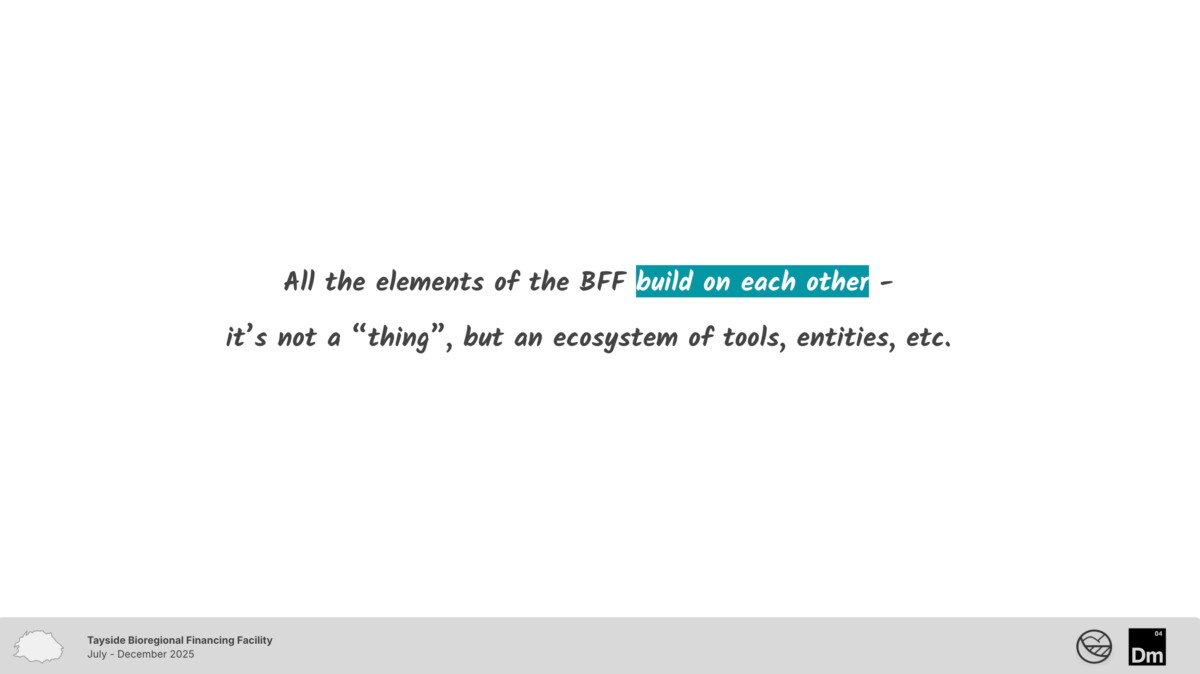
A key realisation has been that the BFF is not a single entity or mechanism. It is an ecosystem shaped by tools, structures, relationships, capacities, and shared understanding. Each pillar reinforces the others. Progress in one area opens possibilities in another.
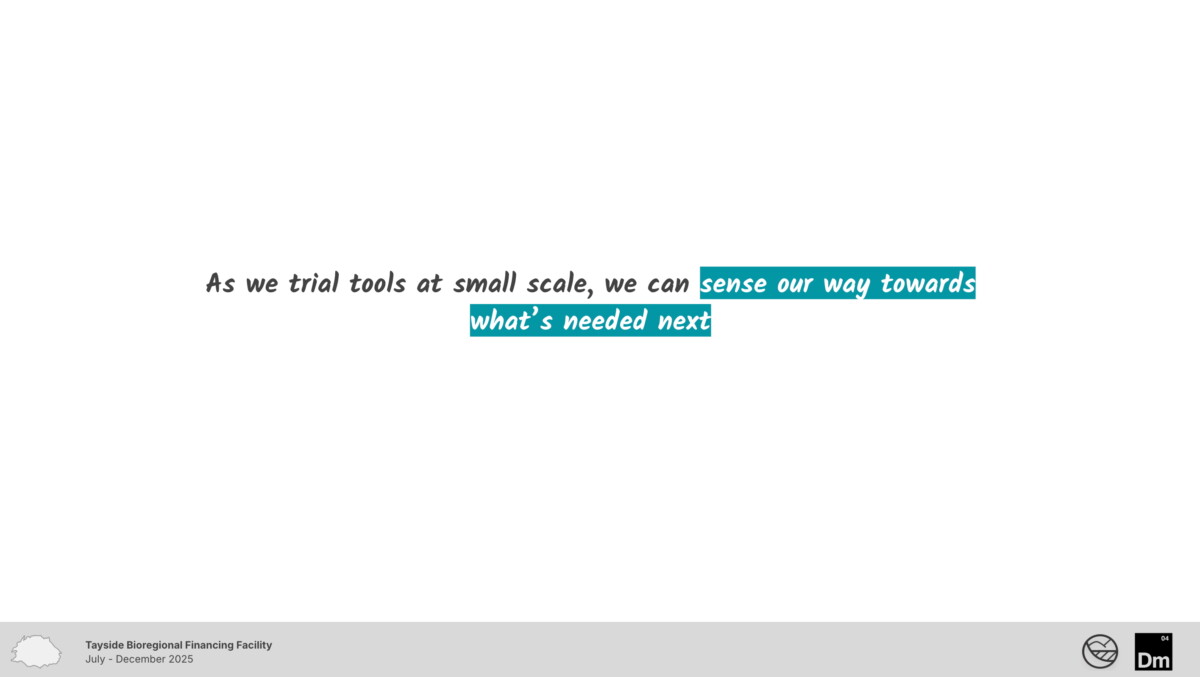
As we trial interventions at small scales, we can feel our way forward — sensing what the Bioregion needs next and adapting in real time.
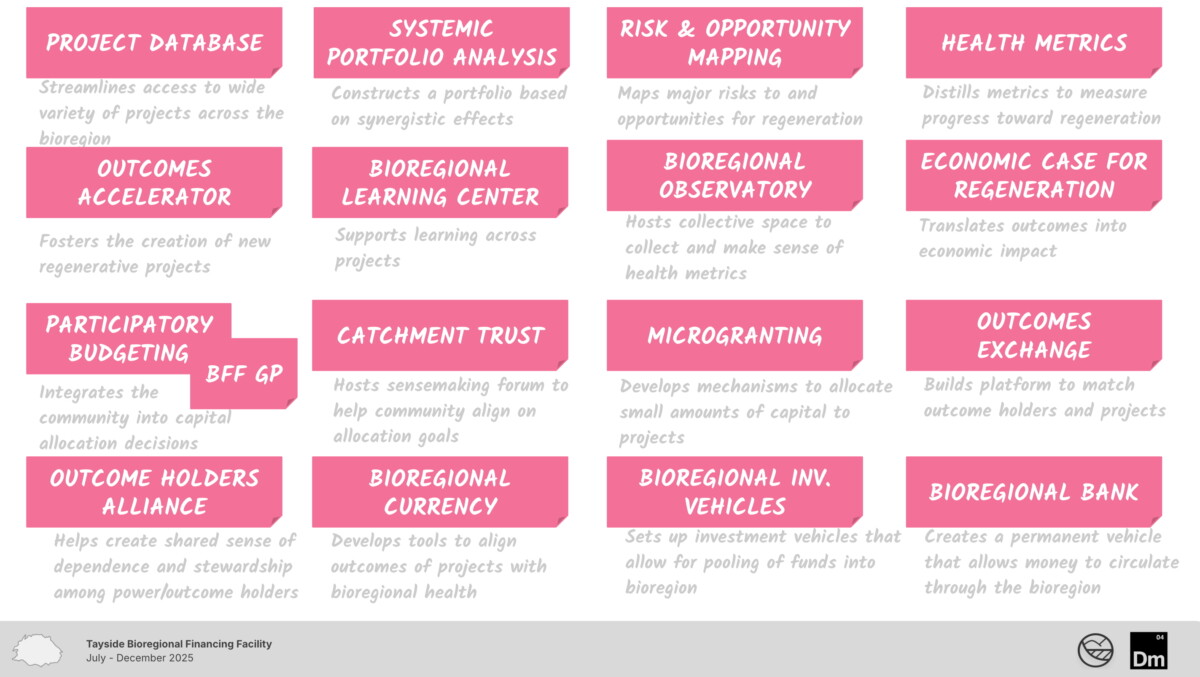
Closing Thoughts
While we’ve separated these ideas into four pillars, in practice they are:
- non-linear
- iterative
- interdependent
- messy and alive
This is how living systems work — and how a bioregional financing ecosystem must work too.
Part by part, relationship by relationship, tool by tool, we are beginning to see the contours of a BFF capable of supporting a regenerative transition in the Tay Bioregion.
This entry was posted in News