Tom Ashton of Native Aqua talks to Nimaya Lemal, Bioregioning Tayside’s Storyteller.
It’s no secret that we have a broken economic model and a sea experiencing ecosystem collapse. We know that these crises are linked: centuries of industrial exploitation and pollution have destroyed biogenic habitats. These include European native oyster reefs, once a keystone species that supported a vast, historic range of aquatic environments, and now declared functionally extinct. But what if the solution is linked, too? What if there were a viable industry model that doesn’t put profit before people, that doesn’t offshore its real costs into our waterbodies and onto our coastal communities, but instead genuinely and strategically improves the place we call home?
I got to virtually sit down with Dr Tom Ashton, head of an ambitious marine restoration and aquaculture company based in Fife on the North Sea, that is reviving the European native oyster (Ostrea edulis) to find out how his company works. Tom shares what it means to be a steward of the sea, the secret to partnering with different sectors effectively, and a vision for the future of Tayside informed by his glimpses of the deep past.
This interview has been edited slightly for clarity and conciseness.
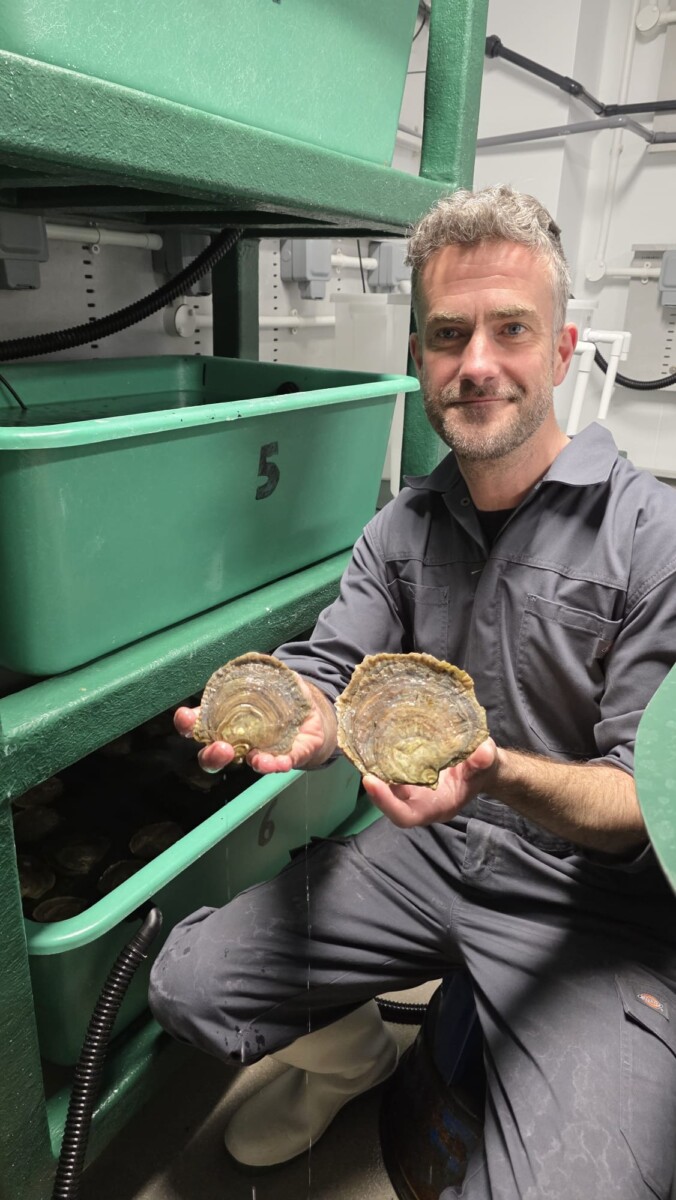
Tom Ashton, photo Native Aqua
Thank you so much, Tom, for taking time out of a busy spring to chat! For those who are new to your work, you are reviving the Native Oyster, Ostrea edulis, who is ‘functionally extinct’ across its historic range. First off, what does that mean and how does it inform your intervention?
That’s right, that just means the populations that are left are too small and fragmented to recover on their own; just leaving the species alone isn’t going to do the job. There’s too few left now that the population could ever come back. So it needs intervention.
And we believe that farming, even as a food product, is the best way to do that.
The rationale is that the way these oysters reproduce is by spawning into the water. The male releases sperm; the female has to filter that out, fertilise and brood her eggs. She needs millions […] of eggs at any one time; she needs to catch a lot. So the only way that really works is if the oysters are in big piles together, in dense communities. Scattered populations with just one over here, one over there just doesn’t work.
There is no naturally reproducing population left.
The only place you do get that kind of density is in a farm: in farm bags, you’ve got the oysters all held together. So when a farm bag decides to spawn together, you get successful reproduction.
We now believe that the only viable source of seed into the wild populations is coming from farms; there is no naturally reproducing population left. If there is, we haven’t found it. Therefore, farming is absolutely vital.
But farming is currently uneconomical.
Why is it uneconomical?
Because the species is essentially inbred now, because it’s gotten so bad. Too few are being bred, which means they don’t grow very well; they die of disease. So they’re uneconomical to farm. Nobody’s got many — they farm the Pacific Oyster.
Farming and conservation work are sometimes pitted against each other. Traditional farming is an economic enterprise — yield, market value, etc., tend to shape farming choices more so than, say, conservation or biodiversity goals. If farming native oysters is uneconomical, why take this approach, as opposed to a more traditional kind of conservation?
What we’re trying to do is use our background in selective breeding and genetic analysis to breed a strong bloodline with good, thorough genetics that increases the numbers out there. Then we monitor and track the contribution to the wild population and hopefully make sure the genetics get back to what it should be – not this impoverished, inbred genetics we have nowadays.
When they’re gone, you’re just left with gravel or mud, a much more impoverished habitat.
Bags of oysters, even if they’re farmed, even if they end up on a plate, before they get there, they’ll have spawned billions of larvae out into the sea. Whereas if we have a bag of oysters and we release them into the wild, they’re probably going to get lost; they’re going to be sitting in the wrong place; they’re going to get eaten by starfish, eaten by crabs, and they’re not really going to contribute anything. One in a thousand is going to survive. If you put them in farm bags, you can look after them, keep them safe, and when they spawn — and they’re in perfect conditions to do so — you then get billions of larvae released into the sea, of which a tiny percentage will survive, but you’re multiplying your numbers. Right?
You hold oysters in a farm cage; the wild gets a multiplier of that. If you release them into the wild, the wild gets a tiny percentage of that. So that’s why we think farming is that crucial mid-step.
We often hear about rewilding on land, but fewer understand rewilding at sea. What does a restored native oyster ecosystem actually look like, and how would Tayside communities, coastal communities, know when it has returned?
So it’s early days, but the thing to do is to go back through historical records and see what historical records say our seas should have. And that is really dense fisheries.
They are more than just an animal; they are a habitat.
Like here in the Tay, for example, we had a big commercial fishery, big boats sailing, going out with big dredges and hauling in tons and tons of oysters. And it was like that all the way around the coast of the UK, mid-sea banks too, like Dogger Bank: huge huge reefs — tons and tons of oysters out in the middle of the North Sea. That’s what it should look like.
And they are more than just an animal; they are a habitat. They are a reef; they are a three-dimensional structure which is then home to countless other things, and when they’re gone, you’re just left with gravel or mud, a much more impoverished habitat. They are fundamentally so much more important than just the shellfish itself. They are a habitat. Plus they filter the water. They remove phytoplankton, which keeps various other ecological systems in balance.
In the modern world, we have eutrophication – plankton blooms as a result of nutrient pollution. Nitrogen and phosphorus coming from all other forms of farming, basically – terrestrial farming washing off the land, fish farming, that sort of thing. And that causes an over-blooming of phytoplankton, which reduces oxygen; it shades the water, which harms kelp forests. It causes an ecosystem imbalance in many different respects.
If the oysters were there in their original numbers, they would be a huge buffer against that. They could easily consume excess phytoplankton and remediate the effects of eutrophication. So they are hugely important for biodiversity and habitat.
You hold oysters in a farm cage; the wild gets a multiplier of that.
And that brings us to what we’re trying to do in the Tay. We know no one is going to eat oysters farmed in the Tay because it’s too close to too many towns and cities and Dundee — the odds of getting edible shellfish are just minimal. But still, build a little farm, put any oysters you can get your hands on in there, and let nature take its course. Let the seed land on all the old banks around the Tay, like Lucky Scalp and all these places that are rich in history of having oysters.
And then, as they reach the end of their reproductive life, replace them with younger ones, and let the older ones, you know, take their chances in the sea.
But I suppose the piece of the puzzle that’s missing here is how we make money on this.
That’s the million-dollar question.
So essentially, you’ve heard of this idea of carbon credits.
Hmm. Yes, I have. Can you explain the idea for those who are not familiar?
Well, ‘greenwashing’ is sometimes the phrase. They’re not all as highly valid as each other. But a good credit is basically an investment by a business in something genuinely beneficial, which happens because of the money you’ve paid, and then you take credit for having caused that benefit, right?
Nutrient-polluting companies need to invest in things that remove nutrients and that increase biodiversity.
The oyster is an immediate, tangible, and very attractive way of making a measurable difference.
Investing in all this genetics and the science of reestablishing oysters is a really worthwhile investment for any company that wants to take a bit of credit for having improved nutrient pollution and improved biodiversity. And this doesn’t just extend to a direct credit from a polluter — we think it’s ideal for that; fertiliser companies, salmon farming industries, heaps of obvious ones who do direct biodiversity damage to the environment should be investing in credits like this.
But also just businesses that want that positive association, who want that good story. A high-end whisky brand would be really appropriate, like a distillery, because they’re custodians. As a brand, they get benefit from this kind of image of heritage and, as a business, doing something good for the environment.
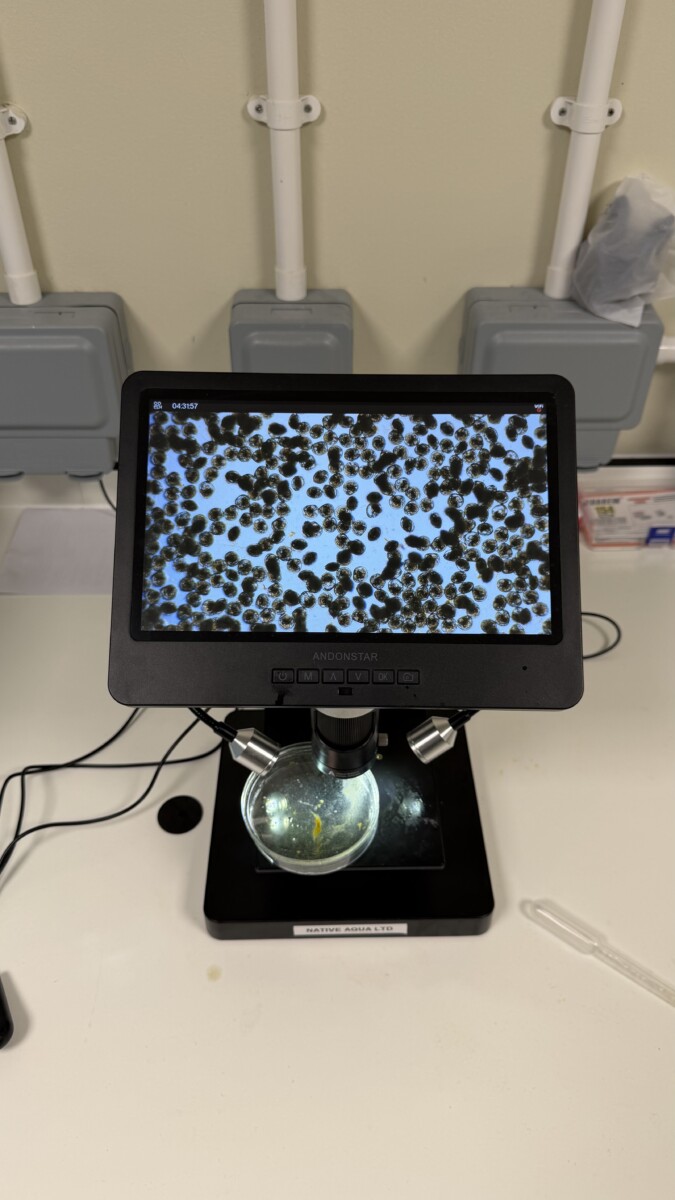 Some newly released Oyster larvae under the microscope, photo Native Aqua
The Tay could be so much better — and it was once so much better.
Then this unit of environmental benefit becomes a commodity. And if demand outstrips supply, we make a profit. Simple as that.
But the genuine benefit that’s being purchased is genuinely good, is verifiable by top-quality science, and is truly meaningful and traceable; it fits all the right criteria for a top investment.
I’ve heard you use the term ‘blue economy’. What does a ‘blue economy’ mean and how do you see it working in Tayside?
So it’s a very nascent idea; the carbon credit market is more established in the terrestrial system. In the blue, [we talk about] things like carbon, nutrient removal, biodiversity — but the core trusted base of that market is still being formed.
This unit of ‘environmental benefit’ becomes a commodity.
We worked with the BSI (British Standards Institute) to help them shape the first British Standard for these kinds of investments. That’s how early it is.
The idea is we help them establish the foundations of what does a proper ‘blue economy credit’ look like, what it should have; what it shouldn’t have. Fundamental principles, like:
Additionality: your money must make something happen that wouldn’t have happened otherwise.
Transparency: you need to be able to verify that there’s benefit — with quality science.
Permanence: it needs to have a lasting legacy.
And there’s one to do with methodology — that it’s repeatable and standardised, that sort of thing.
Where an industry gives back more than it takes to the environment…it is a very rare and precious thing.
Specifically in Tayside…It’s one of the nation’s great rivers, formerly [with] a huge oyster population. The Tay’s a wonderfully vibrant marine environment, lots of birdlife, cetaceans coming and going, but it could be so much better — and it was once so much better.
The oyster is an immediate, tangible, and very attractive way of making a measurable difference. People can get behind it. There isn’t really any downside.
Just the existence of this industry makes the marine environment better than it was.
That’s where we’re going with this, trying to make an attractive investment. We understand that proper credits — and if you think of an actual credit as a financial instrument — we’re a long way off that yet. That’s going to take time to build that trusted marketplace.
What would you say a regenerative economy would do for community in Tayside?
When I think of ‘regenerative’ economy or aquaculture, it’s where the industry itself helps the environment that it’s in.
I mean, in a simple sense, it’s one of those very rare things. Where an industry gives back more than it takes to the environment, it is a very rare and precious thing. There are very few industries, commercial industries that could claim that — that actually make the environment a better place. Oyster farming is one. Seaweed farming, possibly.
Anybody who has activities in the sea has a stewardship role.
Just the existence of this [industry] makes the marine environment better than it was: it improves biodiversity; it clears the water. And there isn’t any downside; there isn’t any chemical, there isn’t any plastic or any pollution or feed or waste. There are no ‘ifs and buts’. I really can’t think of many industries that can genuinely claim to be as regenerative as that. That’s my feeling on it.
The benefit is as simple as that. It just makes the world a better place. And we desperately need that.
It sounds like you’re saying shellfish farming as a form of stewardship — rather than extraction.
Yes.
What does ‘stewardship’ mean to you?
To me, stewardship means having responsibility for something under your care.
Meeting people at a level where they feel inspired and empowered.
It just means it’s fallen to you to look after it. I think anybody who has activities in the sea has a sort of stewardship role.
For a lot of people it’s purely extractive. It’s take what you can, sell it. Get away with what you can get away with. And that’s unfortunately been the sort of overriding human philosophy for far too long…and the sea is in the state that it is.
Part of building that trusted market and a new model seems to come down to effective collaboration. I’m intrigued by your recent partnership with Seawilding. This partnership brings your genetics-led, hatchery science oyster breeding programme to a community-led marine restoration project. What have you learned about how to work effectively across these maybe differing philosophies when it comes to restoration work?
Yes. One of the key things is communication, speaking the right language so that people actually know what you’re talking about.
And meeting people at a level where they feel inspired and empowered by what you’re saying and want to take part in it, but also don’t feel threatened.
If we succeed in what we’re doing, it’ll be a foundational new industry.
I’ve had this in other businesses as well — if people don’t understand what you’re saying, they tend to get a bit defensive. And you need to avoid that. You need to meet people on a level where they get what you’re talking about and want to work with you.
I think with community groups, especially, that’s very important. To that end, I did a talk in Tayport, in the community hall, and invited as many people as I could for that exact purpose. I could tell them what I’m thinking, try to get them excited, and then listen to any queries, concerns or questions and get it all out there in an open forum. That was really effective.
One of the generative questions that’s come up in bioregional conversations is how to look to the past to inform the future. Do you have an answer?
That is what we’re trying to do. We’re surveying at the moment, and in February, there were some big old storms, and it uncovered loads of beautiful big old oyster shells which may have lain there for hundreds of years.
Romans were packing them into large barrels full of snow to take them back to Italy.
We’ve got oysters in the tower in St Andrews which is about a thousand years old, and they’re in the bricks, they’re in the mortar, old oyster shells. [Someone at the open forum] asked: Could you look at their DNA and see what it should be like, and see what you’ve lost?
It’s very difficult in practice, but the thinking is spot on.
The farther back you look in time — “the further back in time you look, the further into the future you can see”* — I’m sure that’s a Winston Churchill quote. Something like that.
Exactly this idea. Let’s see what we’ve lost; the more of history you can absorb, the more you know what you’re aiming for.
*This quote has been paraphrased since its beginning, but it is most likely Churchill’s exact wording was: “The longer you can look back, the farther you can look forward.”
Reminds me of peat records designing future forest restoration, like the Carrifran Wildwood project in Moffat.
There’s lots of ancient wisdom and ancient knowledge, isn’t there, that we really should get back.
Certainly in terms of this species and ecosystem, we need to be looking further back. Things like paleogenetics, even just fossils, just keeping an eye out for evidence, even old historical records — even quirky things like finding oysters in an old building and you think “Hang on, a thousand years ago these guys were building, eating oysters for strength, and crushing up the shells to help with mortar.” It’s a building material; it’s a superfood. It was cheap and easy, which means it was super abundant, just growing on the shores.
It’s not happening out in the depths of the ocean or up in the stratosphere like all these other changes we’re trying to remediate. It’s happening on your doorstep.
There’s documentary evidence of Romans getting oysters from here and taking them to Italy. They were packing them in large barrels full of snow to keep them cool. Romans were taking them back to Italy to eat them and moving them around Europe in vast numbers — because it was nutritious and in its own packaging.
Again it’s this idea of an energy-dense food source that was easily found.
It seems native oysters are a nexus point that ties together many areas of a healthy bioregion: we’ve talked about economics, habitat restoration, we’ve talked about connecting across different sectors, and now we’re talking about superfoods! One of the aims of Bioregioning Tayside is to help people reconnect with the places they inhabit. Can oysters also help people reconnect to this region?
Yeah, like I said, I don’t think we would ever aim to be eating oysters out of the Tay; I think there have been a few too many hurdles for that.
But as a community resource, I think so. It’s quite tangible. It’s a nice marker, a metric. At the moment, you’re not going to find a live oyster, no matter how hard you rummage around the Tay. But in ten years from now? We hope they’ll be all over the place.
You swim over a coral reef, you can hear it, the noises are rich, and you can create a picture of that sound.
And it’s not happening out in the depths of the ocean or up in the stratosphere or like all these other changes we’re trying to remediate. It’s happening on your doorsteps where you go for a walk. It’s something you can physically go and see. And as you start to see them, you know what that means, and you can take some pride in it.
Hopefully we can drum up a bit of community spirit — because it is visible. In the meantime, you can come and see them in a semi-public space like the Tayport Marina. You can do a day, bring the kids, open some bags, pass them round.
It’s a good thing for getting people engaged, because it’s not too obscure or remote; it’s immediately visible.
For young people who might be looking for meaningful work, do you see opportunities emerging in marine restoration over the next decades?
Oh, yeah! If we succeed in what we’re doing, it’ll be a foundational new industry, not just for our business. This idea that you can put a good thing in a marine environment and it’s monetisable- that means it’s a self-sustaining industry; you can create jobs, not just an oyster but also mussel farming and seaweed farming. There are other industries who could benefit from this.
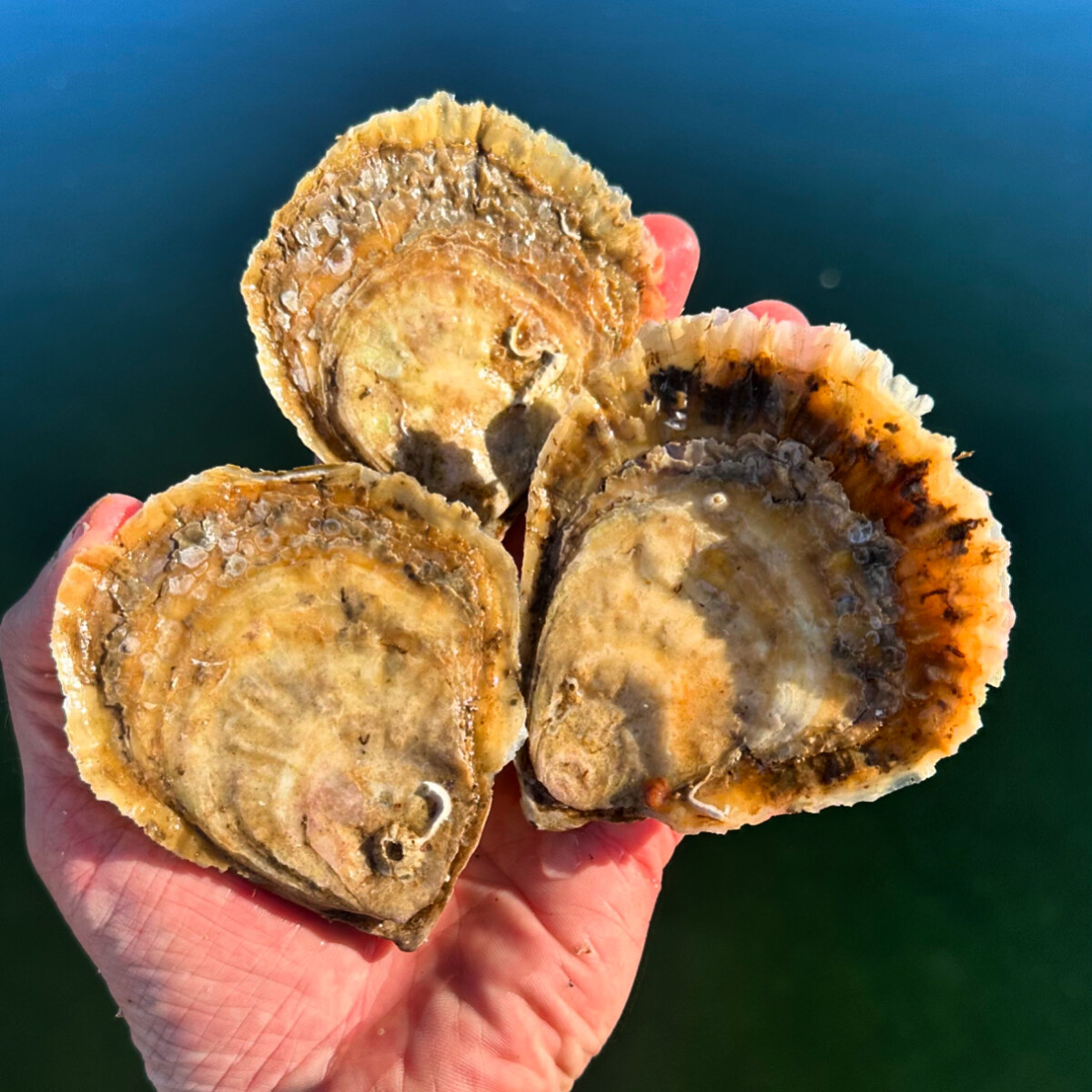 A handful of native oysters, photo Native Aqua
All of this stuff is abundant.
And then there’s all the science that goes with it:
DNA sampling (you sort of filter all the DNA out of the water and break down all the species that are present);
Acoustic monitoring (you can actually create a visual impression of an ecosystem’s health by listening to it. They put hydrophones down. With a coral reef, it’s quite obvious: you swim over a coral reef, you can hear it, the noises are rich, and you can create a visual picture of that sound. We’re attempting that, starting from now, when it’s pretty impoverished and every year, see if that picture is improving as the ecosystem improves);
The hatchery itself (breeding, genetics, DNA testing, DNA sequencing. We’re looking at developing a lateral flow so we can work out if an oyster is female or male, because they change sex).
The work for marine biologists, molecular biologists, ecologists, or bioinformaticians — all of this stuff is abundant. And more grassroots as well; we’re going to need people to go around interact with oyster farmers, hauling bags, scrubbing, husbandry-type jobs, outdoorsy, hands-dirty kind of jobs. They all scale up, if this were to take off…jobs for absolutely everybody.
It just makes the world a better place. And we desperately need that.
It could. It excites me because I’m doing all of these things myself at the moment. [Laughs.] I’m tinkering with all these things like a headless chicken. But if this were to actually mature into a proper marketplace and a proper industry, which we hope it will, then it’s gonna provide a lot to do for a lot of good people.
–
To learn more about the model and Tom’s work, check out Tom’s LinkedIn, Native Aqua’s Instagram, and Native Aqua’s 2-minute blogs.
This entry was posted in News