Bioregioning Tayside has begun work of developing a Bioregional Investment Vision for the River Isla Catchment – a vital natural asset in the Bioregion, sustaining agriculture, biodiversity, and rural livelihoods across Strathmore, while securing water supplies for the eastern Bioregion, including Dundee. The work is being led by Myles and Nicci Mander of EcosystemIQ, based in Lochearnhead but hailing from South Africa. In this post Myles shares some of the learnings from his many years of catchment restoration there and its relevance to the Tayside.
“Across Scotland, we have many excellent people working on the future of rivers, land, water and nature. Farmers, landowners, foresters, fisheries trusts, local authorities, water managers, hydropower operators, conservation bodies, researchers, communities and investors are all active in the landscape. Each brings skill, commitment and knowledge.
But too often they are playing from different music sheets.
One group is working on peatland carbon. Another on natural flood management. Another on riparian woodland. Another on biodiversity. Another on agricultural resilience. Another on drinking water quality. Another on hydropower. Another on rural development. All are important. All may be well-intentioned. But the river hears them together.
A catchment is not organised by policy silos. It does not separate climate adaptation from food production, or flood risk from biodiversity, or water quality from soil health. A river integrates everything that happens across the landscape. It is the score made audible.
This is why the Tay Bioregion needs not just more projects, but better orchestration.
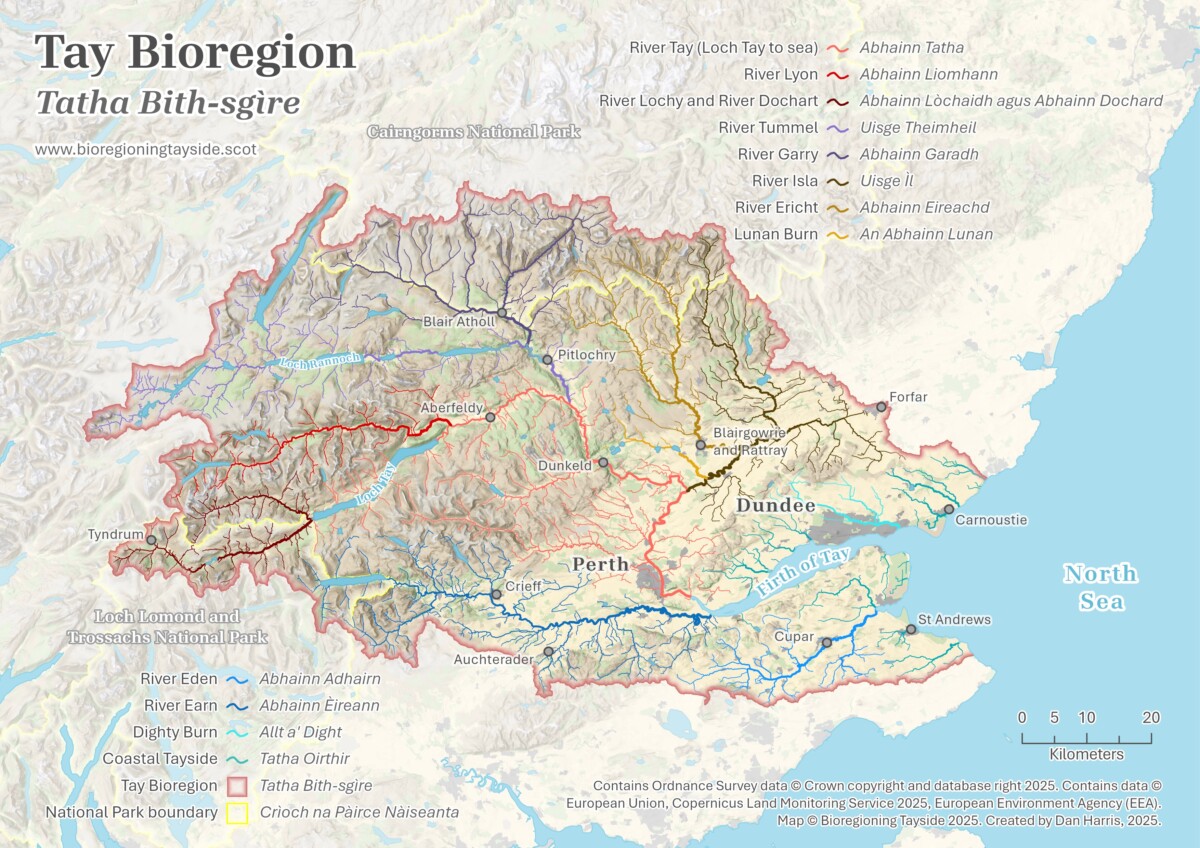 A map of the Tay Bioregion by Dan Harris
The Catchment as an Orchestra
Imagine the Tay Catchment as an orchestra.
The peatlands are the deep strings, holding water, carbon and memory. The rivers and burns are the woodwind, carrying movement and voice through the landscape. The floodplains are the percussion, absorbing shocks and releasing energy. The woodlands are the brass, giving structure, shelter and resonance. The soils are the bass line, often unseen but holding the whole composition together. Farms, villages, towns, businesses and communities are not outside the music; they are part of it.
At present, Scotland has many talented musicians. What is missing is the conductor and the shared score.
Without a conductor, each section plays its own piece. Peatland restoration pursues carbon targets. Flood projects pursue flood metrics. Agricultural schemes pursue farm-level outcomes. Biodiversity projects pursue habitat gains. Hydropower schemes pursue generation. Water utilities pursue supply and treatment. Each may succeed on its own terms while the catchment as a whole remains out of tune.
The result is not failure through lack of effort. It is fragmentation through lack of orchestration.
The opportunity for Bioregioning Tayside is to become the conductor: not by controlling every musician, but by helping them hear one another, align timing, understand the whole composition, and play toward a shared future for the Tay.
The South African Lesson: Ecological Infrastructure as the Score
A powerful South African study on ecological infrastructure offers a useful way forward. The researchers asked a question that is deeply relevant to Scotland:
What happens if we invest not only in pipes, pumps, dams and treatment works, but also in the living landscapes that create, store, filter and regulate water?
Their work showed that restoring ecological infrastructure in strategic catchments could generate measurable hydrological benefits: improved streamflow, stronger baseflow, reduced sediment, better drought resilience and benefits comparable in cost to some conventional infrastructure options.
The lesson for Scotland is not that South African interventions can be copied directly. The landscapes are different. The climate is different. The institutions are different.
The lesson is methodological and practical.
The South African work shows how to turn catchment restoration from a hopeful environmental story into a quantified investment case. It combines hydrological modelling, economic valuation, stakeholder engagement and spatial prioritisation. In musical terms, it helps write the score.
For the Tay and the River Isla, this is exactly what is needed.
We already know that peatlands, rivers, floodplains, wetlands, soils, woodlands and farms are connected. We know that upstream land management shapes downstream water quality, flood risk, summer flows, sediment loads, biodiversity and economic resilience. What is now needed is a shared catchment score that shows where interventions should happen, how they interact, who benefits, who pays, and how the whole system becomes more resilient.
Moving Beyond the Language of “Asset Class”
It is tempting to describe catchment restoration as a new asset class. That language can be useful in some settings because it signals that nature is not simply a cost. It reminds investors and policy-makers that ecological systems provide real services and generate real economic value.
But for catchments, the phrase can also mislead.
A catchment is not a private asset in the way a building, wind farm, timber plantation or infrastructure concession might be. It is a living public-good system. Its benefits are shared, layered and often difficult to divide neatly. Cleaner water, reduced flood risk, healthier soils, restored biodiversity, cooler rivers, improved resilience and stronger communities do not belong to one buyer or one balance sheet.
The Tay should not be reduced to a commodity.
A better framing is this:
Catchment restoration is public-good delivery infrastructure.
It is infrastructure because it performs essential functions for society. It stores water, slows water, filters water, cools rivers, holds carbon, supports food production, reduces risk and sustains life.
It is public-good infrastructure because many of its benefits flow beyond the person or organisation that pays for the work. The farmer who restores soil may help downstream water quality. The landowner who restores peat may help flood resilience. The community that supports riparian woodland may improve fish habitat, shade rivers and reduce future climate risk. The benefits travel.
This means the financing model cannot be a simple private investment model. It must be a blend.
From Asset Class to Funding Chorus
If the catchment is an orchestra, finance must be a chorus, not a soloist.
No single funding mechanism will restore the Tay. Carbon finance alone will not do it. Biodiversity credits alone will not do it. Public grants alone will not do it. Water company investment alone will not do it. Philanthropy alone will not do it. Private capital alone will not do it.
The task is to blend different sources of finance around a shared catchment plan.
Public funding should support the public-good foundation: flood resilience, biodiversity recovery, climate adaptation, community benefit, water security and long-term stewardship.
Private and regulated finance can support benefits with clearer beneficiaries: reduced water treatment costs, sediment management, hydropower resilience, carbon storage, biodiversity uplift, supply-chain resilience and avoided infrastructure costs.
Philanthropy and mission-led capital can help with early-stage design, convening, modelling, innovation and risk absorption.
Communities can contribute legitimacy, local knowledge, monitoring and stewardship.
The conductor’s job is to make sure these voices sing together.
Bioregioning Tayside as the Conductor
Bioregioning Tayside is well placed to play this role because it does not begin with a single sector. It begins with place.
The bioregional approach asks: what does this living system need in order to thrive?
That is a different question from: how do we deliver this grant scheme, this target, this project or this regulatory obligation?
For the Tay catchment, the conductor role would involve bringing the players together around a shared score. That score would identify priority places for intervention, clarify the benefits each intervention can generate, sequence action over time, and connect funding sources to outcomes.
This does not mean creating another layer of bureaucracy. It means creating the missing integrating function.
The conductor does not play every instrument. The conductor helps the orchestra become more than the sum of its parts.
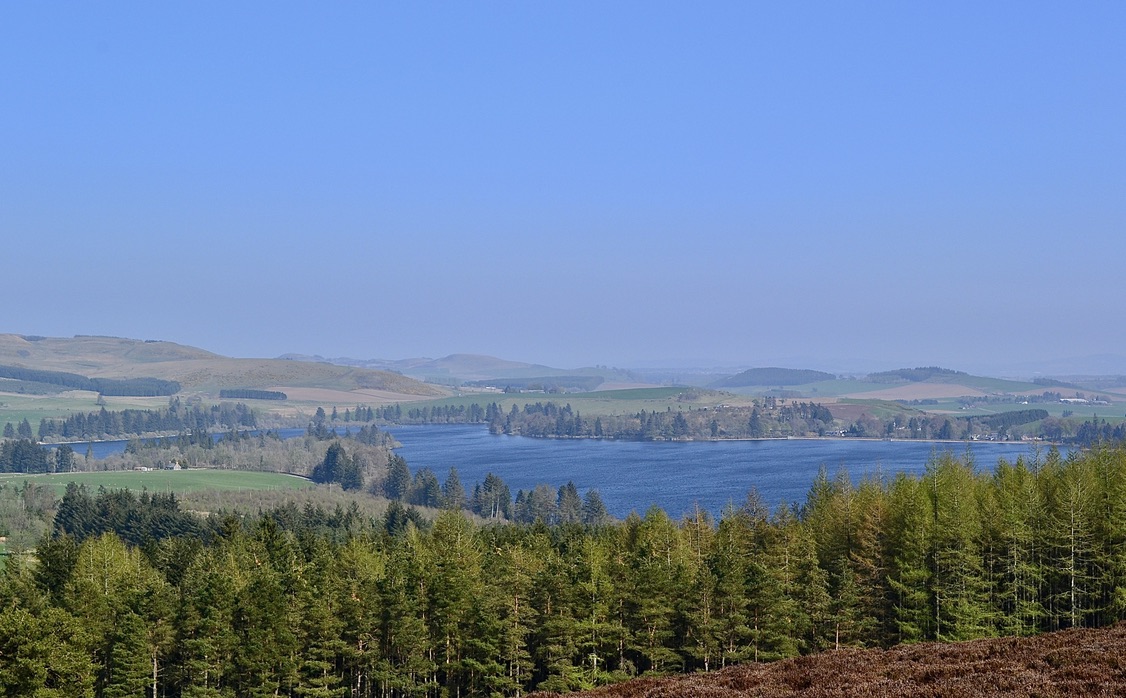 Backwater Dam in the Isla catchment, part of Dundee’s fresh water supply, photo Clare Cooper
The River Isla as a First Movement
The River Isla catchment could become the first movement in this wider Tay composition.
The Isla already contains many of the elements needed for a practical demonstration: peat soils, productive farmland, river networks, floodplain opportunities, biodiversity potential, water-quality pressures, downstream beneficiaries and emerging partnerships.
The existing River Isla work has already made an important conceptual leap. It frames the catchment not as a collection of separate land uses, but as an integrated living system. It identifies water as the keystone value because water connects upstream stewardship with downstream benefit.
That insight is crucial.
Water is the thread that ties the orchestra together. It connects peatland condition to river flows, soil health to flood risk, woodland cover to water temperature, farming practice to sediment, floodplains to downstream communities, and ecological recovery to economic resilience.
For the Isla, the next practical step is to build the shared score through hydrological and economic modelling.
Writing the Shared Score
A Tay or Isla catchment score would not be a metaphor only. It would be a practical tool.
It would map where water is generated, stored, accelerated, polluted, warmed, abstracted and released. It would identify which areas matter most for summer low flows, sediment reduction, natural flood management, water quality, biodiversity recovery and carbon storage.
It would then test different combinations of interventions:
Peatland restoration where it improves water regulation, carbon storage and downstream resilience.
Riparian woodland where it cools rivers, stabilises banks, improves habitat and intercepts sediment.
Wetland and floodplain restoration where it slows flood peaks, stores water and creates biodiversity value.
Regenerative farming where it improves soil structure, infiltration, productivity and resilience.
Deer and grazing management where it allows vegetation recovery and reduces erosion.
River restoration where it reconnects channels, habitats and floodplains.
Hydropower and abstraction coordination where low-flow resilience and energy production need to be balanced.
The purpose would not be to produce a perfect model. The purpose would be to make better collective decisions.
A good score allows each musician to understand not only their own part, but how their part contributes to the whole.
Practical Steps for the Tay Bioregion
The discussion becomes practical when it moves from inspiration to sequence.
First, establish the catchment table. Bring together the key players around the Isla and wider Tay: land managers, farmers, local authorities, Scottish Water, SEPA, fisheries interests, conservation bodies, hydropower operators, community groups, researchers, businesses and funders.
Second, agree the shared outcomes. These should include water security, flood resilience, water quality, biodiversity recovery, carbon storage, agricultural resilience, community wellbeing and economic adaptation.
Third, commission hydrological modelling. This is the missing technical foundation. It should identify where interventions will have the greatest effect and how different actions interact across the catchment.
Fourth, build a blended finance map. Identify which outcomes are public goods, which have identifiable beneficiaries, which can attract private or regulated finance, and which require public support.
Fifth, create a catchment investment portfolio. Move beyond isolated projects and assemble a coordinated programme of interventions across peatlands, rivers, farms, floodplains, woodlands and wetlands.
Sixth, establish long-term monitoring. The catchment score must be adaptive. As the orchestra plays, the conductor listens and adjusts.
The Holy Grail: Harmony Between the Parts
The greatest value will not come from any single intervention.
It will come from synergy.
Peatland restoration becomes more valuable when connected to floodplain reconnection. Riparian woodland becomes more valuable when linked to river restoration. Regenerative farming becomes more valuable when supported by soil monitoring, water-quality outcomes and supply-chain incentives. Hydropower becomes more resilient when sediment and low-flow risks are managed across the catchment. Communities benefit more when restoration also supports livelihoods, skills and local identity.
This is the holy grail: not just funding more projects, but composing a living system in which each investment increases the value of the others.
That is what fragmented funding cannot achieve on its own.
That is what a bioregional conductor can help unlock.
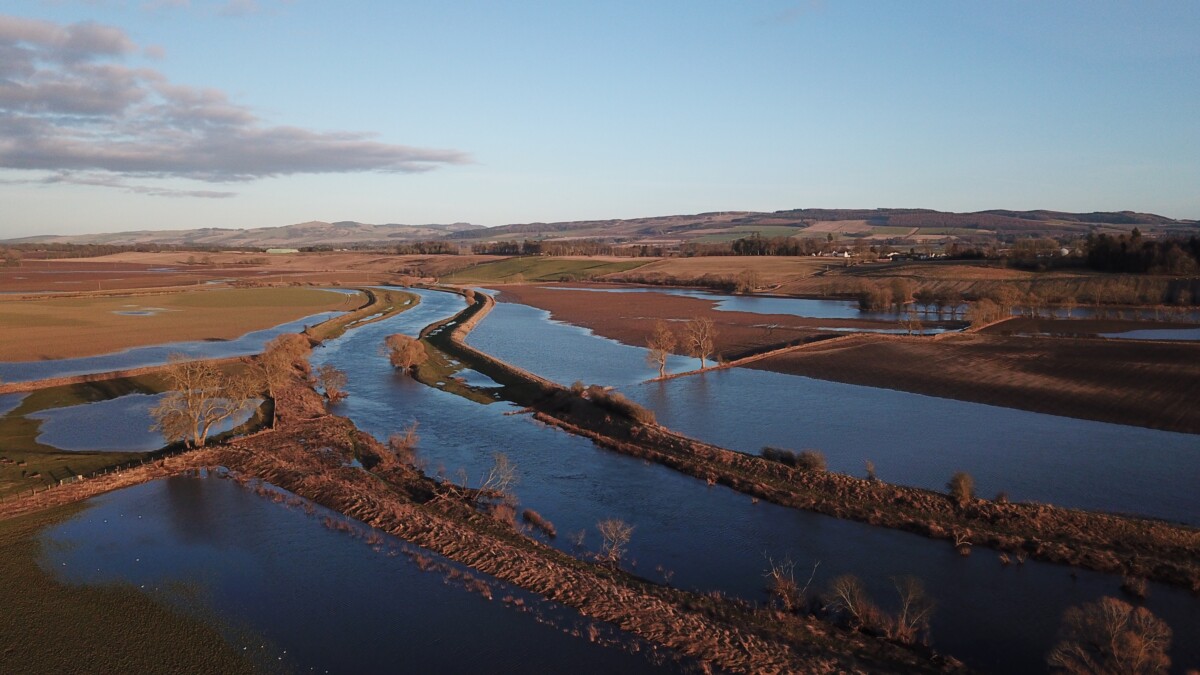
The River Isla in flood, phot0 Markus Stitz
A New Question for the Tay
The old question was:
How do we fund nature restoration?
The new question is:
How do we orchestrate investment in the living infrastructure of the catchment so that water, land, climate, biodiversity and livelihoods become mutually reinforcing?
For the Tay Bioregion, this is not an abstract question. Climate change is already altering the timing, intensity and reliability of water. Rivers are being asked to carry more risk. Farmers are facing uncertainty. Communities face flood and drought pressures. Infrastructure is ageing. Biodiversity is under strain.
The choice is not between economy and ecology. The economy depends on the ecology.
Healthy catchments are not scenery around the economy. They are part of the economy’s foundation.
If Bioregioning Tayside can help the Tay catchment find its conductor, write its score and bring its musicians into harmony, the River Isla could become more than a restoration project. It could become a working demonstration of how Scotland learns to invest in the living systems that make resilience possible.
In an age of climate instability, that may be one of the most important compositions we can write.”
This entry was posted in News