Not everyone knows that the Tay Bioregion produces the majority of Scotland’s soft fruit. (1) Fewer still know how the particular combination of rhizomatic soil, water, and climate shapes what can be grown and made here.
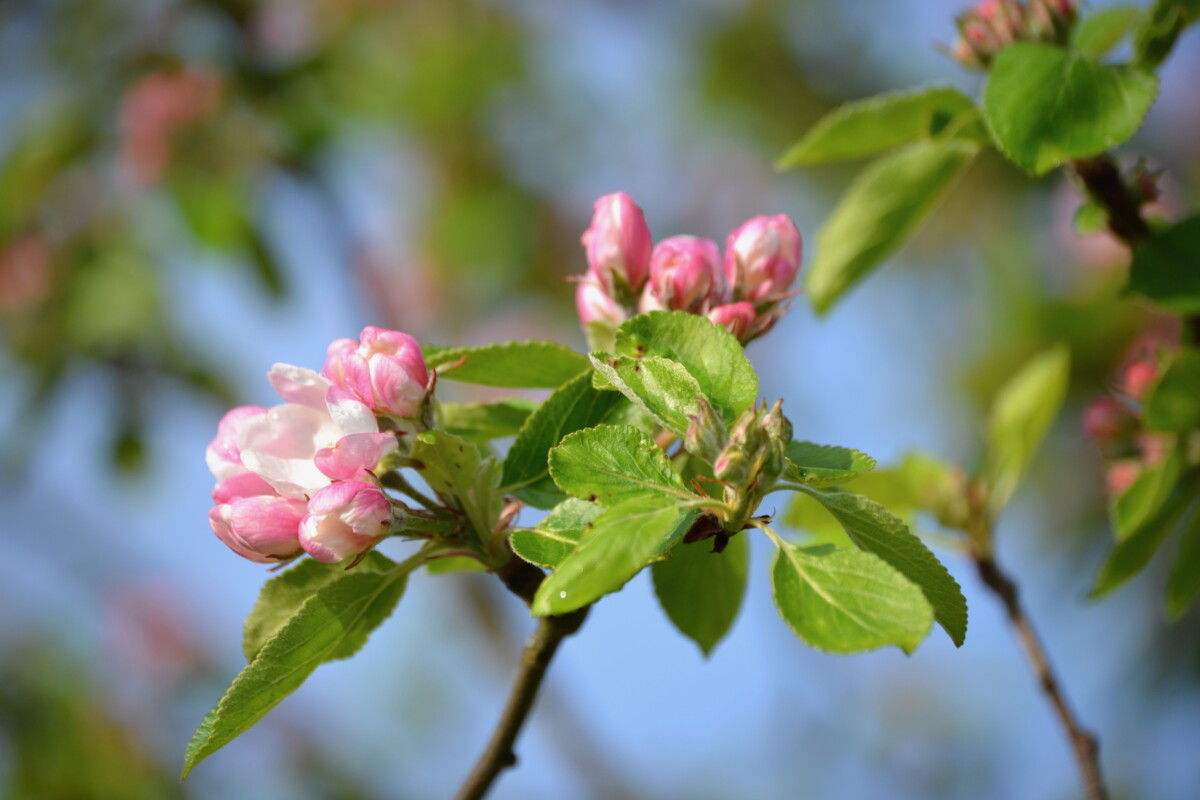
Apple Blossom, photo Clare Cooper
But autumn reminds us that at the heart of this Bioregion’s food world, often drawing little attention to themselves, are hard fruits too – apples and pears – together with the artisanal cider and perry making that they enable. These are important – our recent mapping project found – particularly as the climate changes.
Digging into this centuries-old craft makes it clear that our fruit trees, while easy to take for granted, are special. These familiar species are doorways to knowing and loving this region better.
Why should we pay attention to cider and perry production around the Tay Bioregion?
Our colleague Viv Collie recently led a project to identify and promote our local cider and perry producers, but she quickly found the production reflects a larger system. “I started off thinking this was about how to sell more cider and perry,” she said. She soon realised that the project involved the producers, the orchards and the unique soil around the River Tay.
This reflects the 800-year-old history of fruit tree planting in the area.
It’s all about time.
Newburgh is a small town situated on the south shore of the River Tay at the head of the Estuary. It was founded in 1191 by monks from Thiron in France and is historically known as Scotland’s Fruit Town.
Tricia Anderson, chairs the Newburgh Orchard Group and shared her thoughts on the town’s historic links with fruit trees. Tricia’s own historic property in Newburgh includes a centuries-old orchard. It is telling that Tricia ranks her home’s connection to Patrick Matthew (a figure of the 1800’s, notable for his large orchard in the Carse of Gowrie) alongside her home’s connection to Mary Godwin (Shelley) – the author of Frankenstein, who stayed in the property once on a visit to Dundee.
Monks developed the rich soil and planted fruit trees.
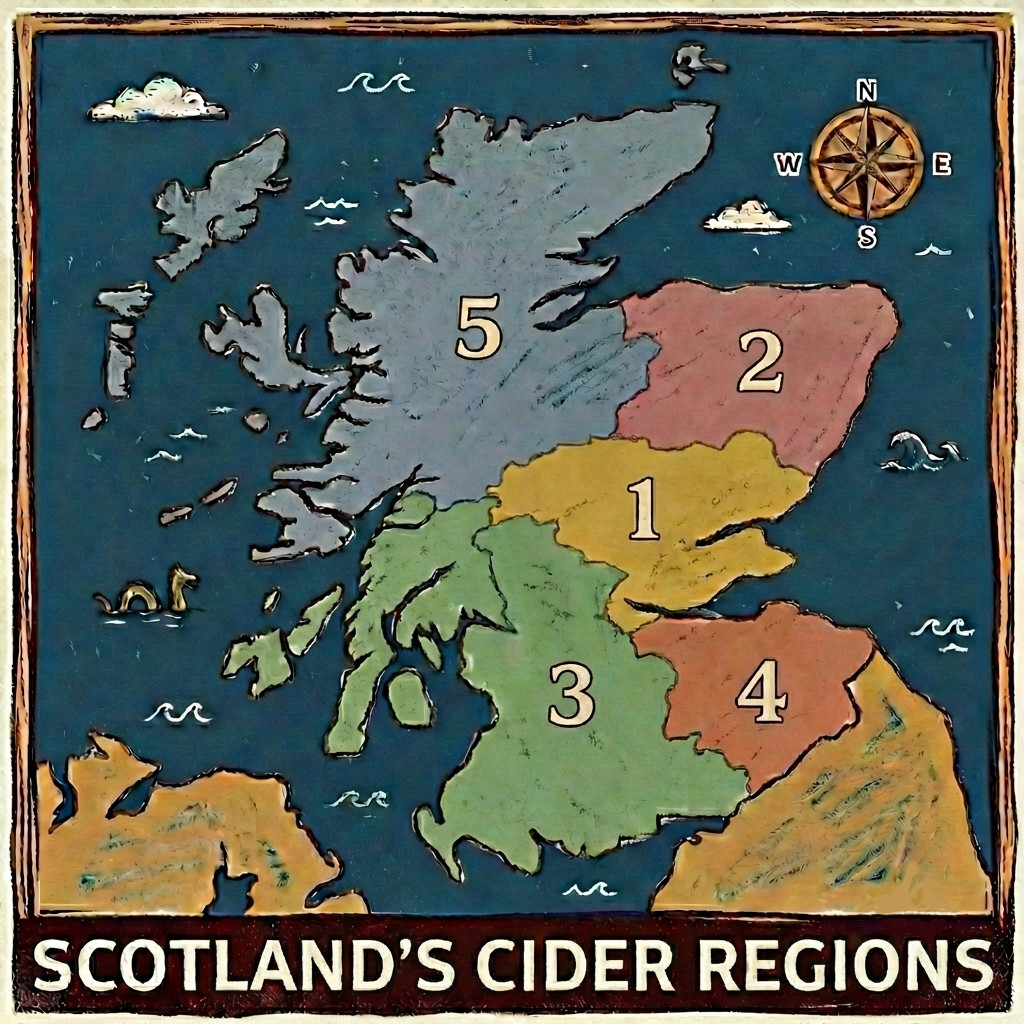
New map of Scotland’s Cider Regions by the Caledonian Cider Company
Tricia wrote an article for The Caledonian Gardener (2024), in which she explains:
“The monks developed the rich soil and planted fruit trees, brought with them [from France]. Pears, apples and plums were grown for their own consumption, to make alcohol, to trade and to supply the Scottish royal court at Falkland Palace…Their fruit was famous throughout Scotland.”
Ecologically, the soils tracing the River Tay Catchment System are indeed special. They are a matrix of rich silts and clays that retain moisture without becoming waterlogged.
However, the monks are not the only ones who shaped this soil. Wild reeds (Phragmites australis) naturally aerate the clay, creating the conditions for extensive underground root networks to flourish.
Their fruit was famous throughout Scotland.
Long before the 20th century’s shift toward soft berries and fruit breeding (read: the Tayberry), expansive top-fruit orchards filled the Carse of Gowrie and beyond – we know because the soil tells us.
The dense, clay soil has preserved unique, centuries-old varieties of traditional apples and pears that are entirely distinct to the inner Tay estuary.
The craft reflects a relational system.
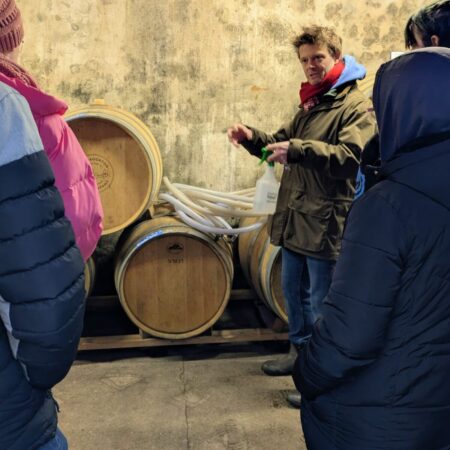
Visit to Naughton Cider, photo Viv Collie
Cider and perry making in the River Tay catchment area goes back hundreds, if not over a thousand, years, and today’s cider and perry making still requires this special soil, with its deep root network that enables the plants’ resilience.
The craft reflects a relational system: it requires seeds and stories to preserve knowledge of which trees to plant; the orchards need people to plant, pick, and prune trees; the cider and perry makers need pollinators and a predictable climate.
Many players in and across the region come together in cider and perry making. Customers and visitors to the area can now taste these products, appreciate the skills required in production and learn the stories about the historic orchards.
Hyperlocal food growing as resilience – Why we hosted “From Tree To Glass”.
But celebrating local food heritage is only half the story.
What is the most effective way to relocalise and build resilient food networks?
Viv’s project, titled “From Tree to Glass – Promoting Craft Cider and Perry Production in Tayside and North Fife”, was funded through Scotland Food and Drink’s Regional Food Fund and hosted by us, Bioregioning Tayside. The mapping project was sparked by our 2023 “Feeding Tayside through Climate Crisis” conference, which essentially asked:
Given the high risks to the region’s security posed by biodiversity loss and climate change, what is the most effective way to relocalise and build resilient food networks across Angus, Dundee, and Perth and Kinross (the Tay Bioregion)?
Our cross-sector conference identified several answers amd organised the mechanisms for supporting food system transformation in Tayside into an accessible diagram or “intervention wheel” (see graphic below).
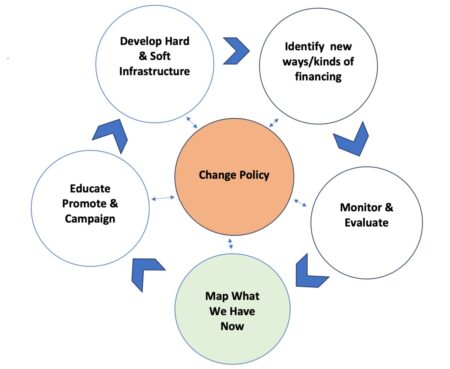
Significantly, our previous food-mapping work found that only a few groups and organisations interact with other groups and networks. So it was clear that a strong starting point is to map what we have now.
It’s a first step towards exemplifying how small regions can make big changes around food sovereignty.
“From Tree to Glass” did exactly that. The project set out to map and strengthen collaboration among growers, educate the public, and explore opportunities to develop the sector. It is a first step towards making our region stronger – and for showing the rest of the country that small regions can make big changes around food sovereignty.
The project overachieved on all targets. On paper, Viv’s numbers stand out: over 30 orchards mapped, 10 producers interviewed on camera, 5 public “Cider Series” events attracting a wide range of visitors – and the project reached around 20,000 people through project communications.
The project overachieved on all targets.
“From Tree to Glass” brought producers together through networking events; it built partnerships with organisations (including Fife College, the Howe Beer Project, Orchard Revival, Scottish Apple Producers and Buglife), and its visits and workshops provided training for students.
There is strong enthusiasm among this cluster for greater collaboration and shared learning.
Rather like the rhizomatic soil of the River Tay valley, the project supported the connections and skills-sharing matrix that encourage cider and perry production.
Relocalising food networks is about celebrating local food traditions while planning ahead for future generations. Viv’s findings help show why orchards are an important part of that project.
Lessons for the Bioregion
While the project has many more technical findings, three broad takeaways stand out for the future of the Bioregion as a whole.
1. Orchards can help us adapt to climate change
Beyond creating high-quality local products, orchards perform important ecological functions for the region. They preserve heritage varieties and play a key role in supporting its biodiversity.
Fruit teaches future planning.
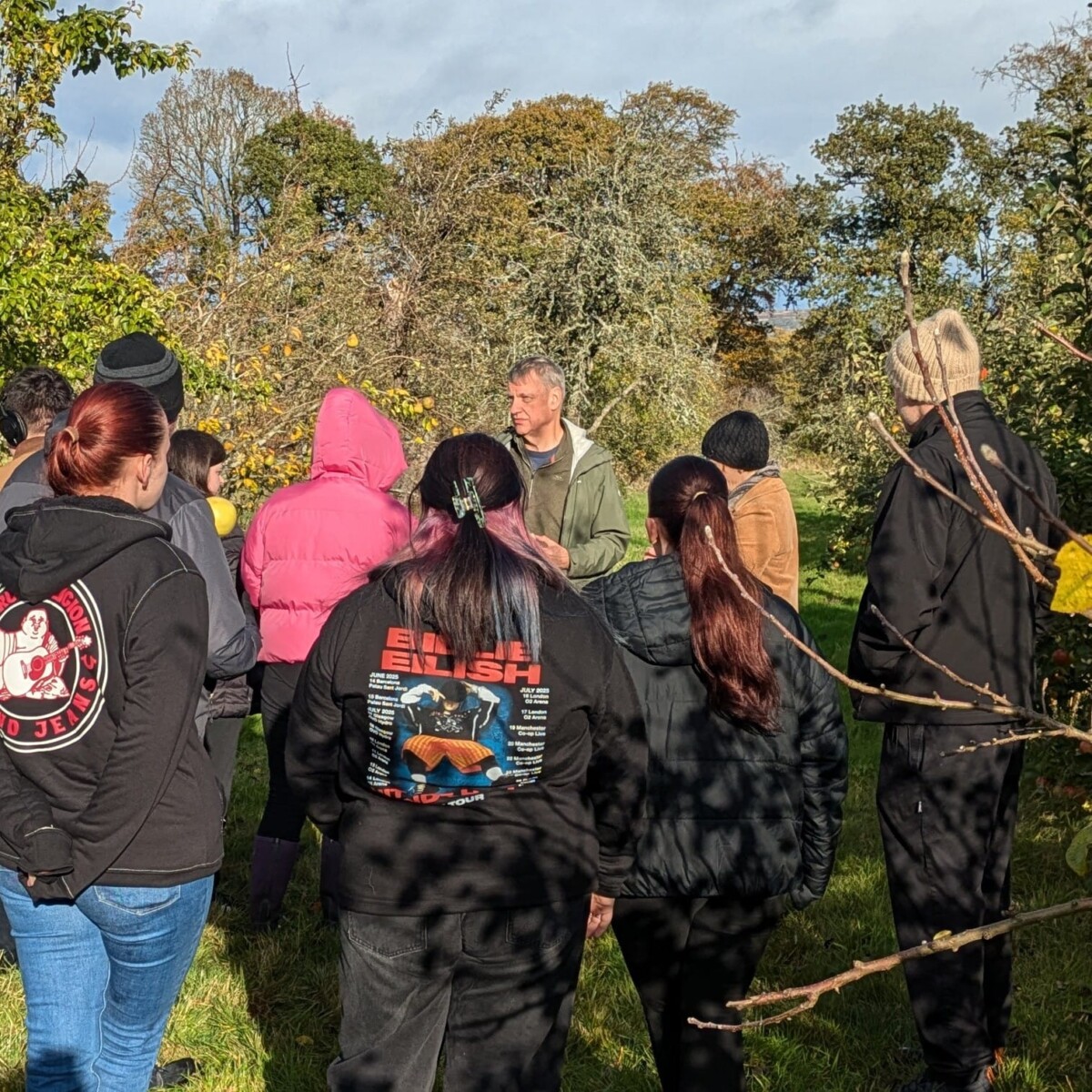
Fife College visit to Megginch castle, phot Viv Colllie
In terms of systems thinking, the fruit itself teaches future planning. Like in wine-making , the outcome of each harvest dictates the results for that year.
Producers think in decades, not seasons. This constraint lends itself to long-term thinking.
Think in decades, not seasons.
Given the rapid fluctuations in temperature and the way species are changing under climate change, “We could be thinking 25 years ahead”, says Viv.
The Tay Bioregion may play an important role for fruit growing in the UK and Europe as the planet warms.
2. We have the means for a stronger orchard fruit-growing network in the Tay Bioregion
There is an interest from producers across the region for greater collaboration.
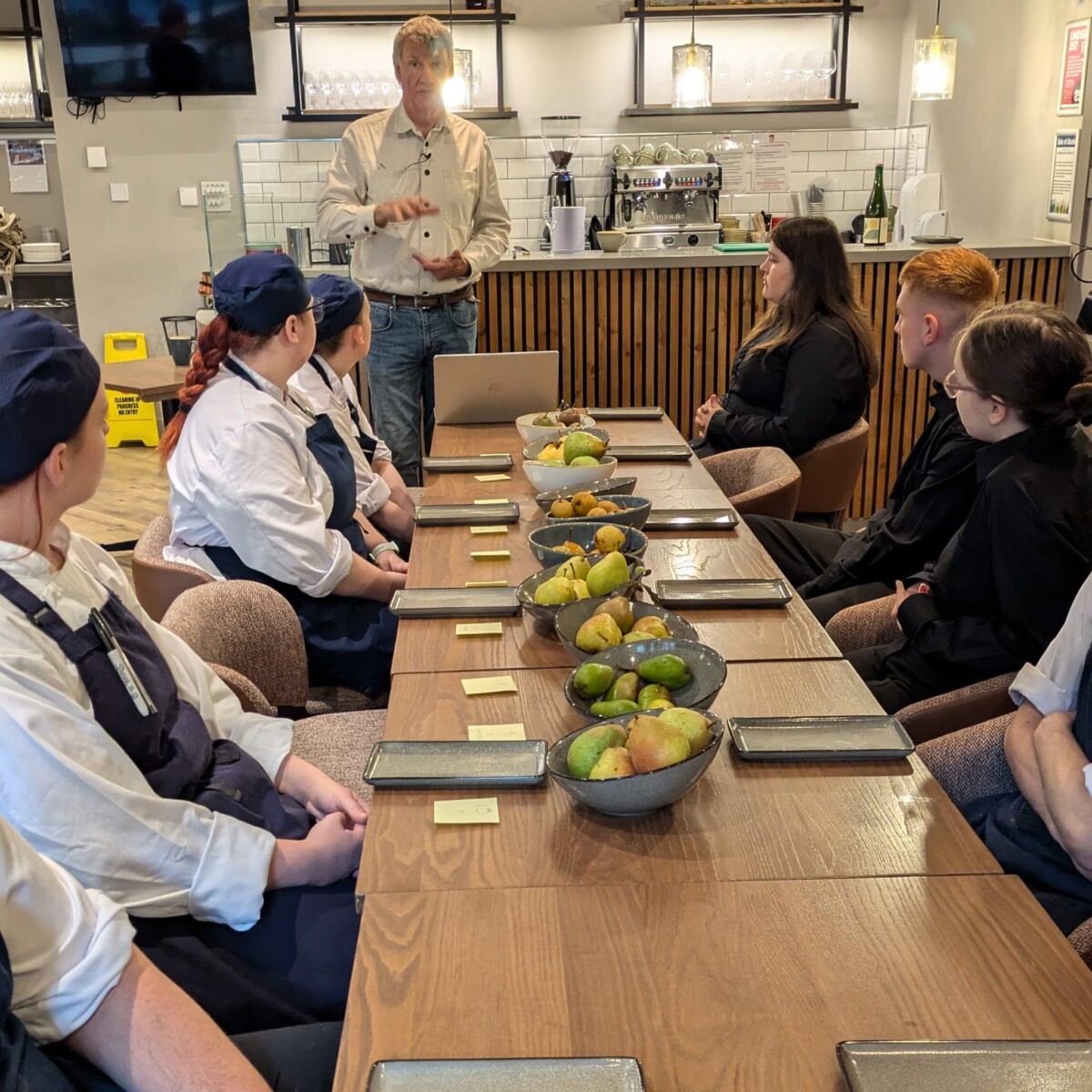
Tutored pear tasting at Fife College, photo Viv Collie
The River Tay catchment has a strong cluster of high-quality, distinctive cider and perry producers. These producers share common values around sustainability, biodiversity and minimal-intervention production. Viv’s study finds there is strong enthusiasm among this cluster for more opportunities to work together and share learning.
3. Celebrate fruit trees
Tricia notes the lack of awareness about the trees and their history. Reflecting on tourism and the season of apple blossoms in Newburgh, she adds that visitors and new arrivals are sometimes “better at seeing what we have than we do.”
Appreciation of fruit trees, their history and their products, strengthens an engaged, meaningful connection to the land.
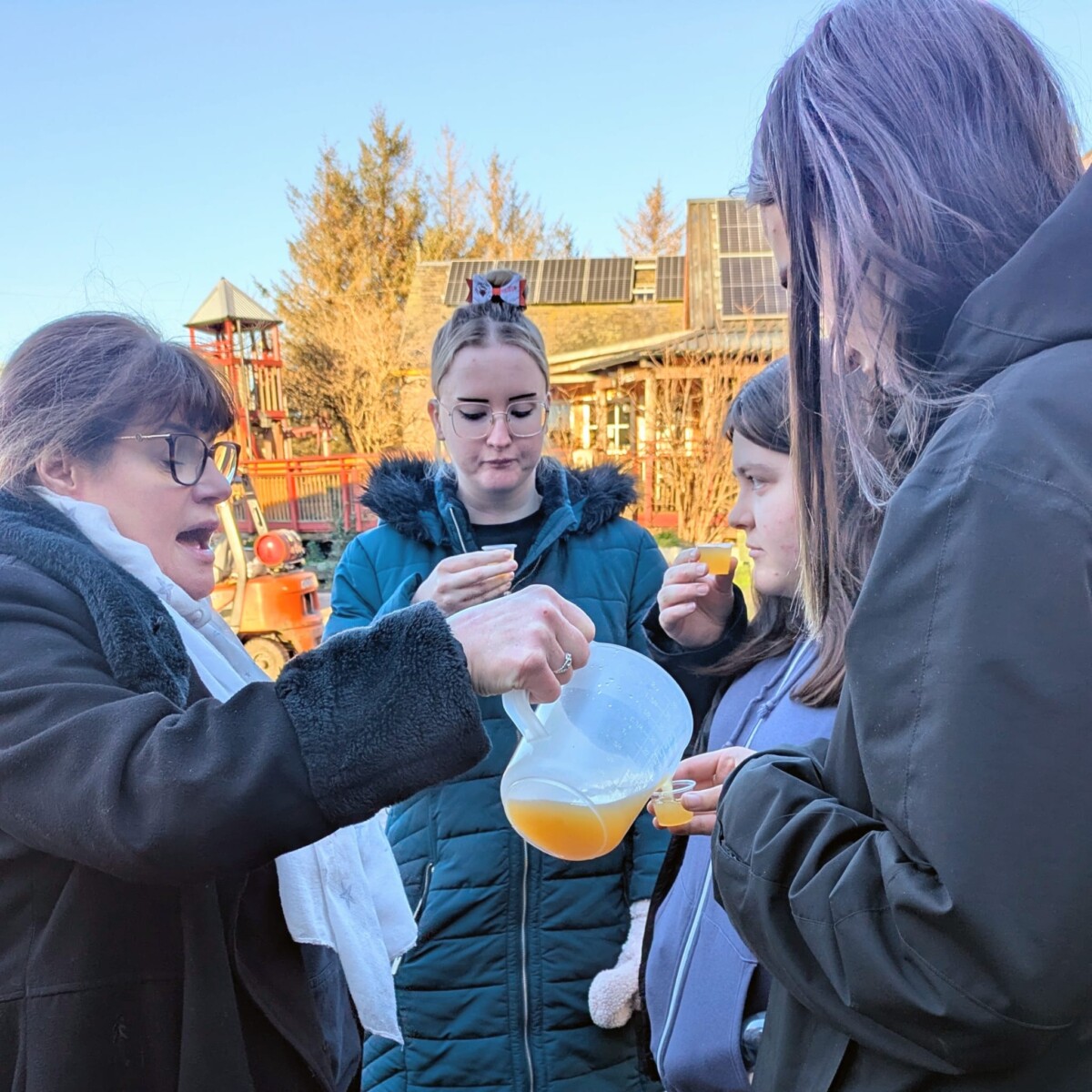
Fife College learning journey to Cairn O’Mhor cidery, photo Viv Collie
Many of us have community orchards and roadside apple trees, but generally, few people turn out to prune the trees and use the fruit. Those who do, Tricia says, get more out of it than fruit.
There is an old tradition of honouring the trees of Scotland, Tricia reminded me.
“If something is growing, you have to nourish it and use it”
Reflecting on the lessons and gratitude that come from taking an interest in fruit trees, Tricia adds, “If something is growing, you have to nourish it and use it.” Appreciation of fruit trees, their history and their products, strengthens an engaged, meaningful connection to the land and to each other.
Our fruit trees are and should be a point of cultural pride, and cider and perry are one way to come back to seeing and loving our region in a fresh way. Viv’s findings agree with much of what Tricia’s experiences indicate: The benefits of enjoying fruit trees in the Tayside Bioregion are right there for the taking – but engagement could be increased. More storytelling, tastings and public engagement are needed to increase appreciation of cider and perry as premium local products.
“In this time in history, everyone is desperate for community,” Tricia explains. Tricia’s experiences highlight the way orchards build social connections and connections to old ways.
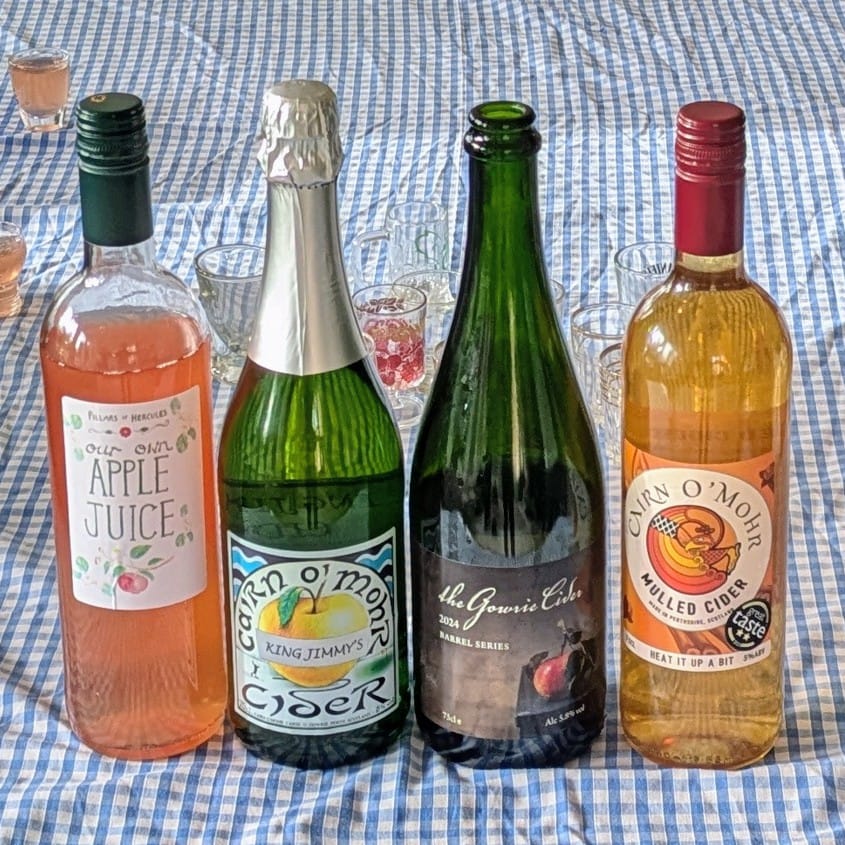
Fife College visit to Megginch Castle, photo Viv Collie
Interested in knowing more about orchard growing in Scotland? Check out SAP, a national organisation for Scottish Apple Producers: https://scottishapples.co.uk/
Find more information about the national cider scene on the national Cider Map produced by Ryan at Caledonian Cider.
And explore our StoryMap, which maps community-led food Growing in Tayside, including community orchards.
Take action:
Support your local perry place or cidery!
Those mapped include
Those mapped include Social Juice; Naughton Cider; Barn Owl Orchard; Cairn O’Mohr; Digger’s Fine Cider; Aipple; Flemings Fife Cider; Wasted Degrees; Harvest Brae Farm
This autumn, join a local apple day! Or start even closer to home: see what varieties are in your garden or community orchard – and use the fruit!
[1]“Arable Farming”. NatureScot. (2025). [Webpage]. Accessed 10 September 2026.
This entry was posted in News